Tesla's second-quarter 2026 results split cleanly into two very different stories. Read the income statement and it was a rough quarter: earnings missed badly, margins compressed sharply, and free cash flow turned negative. Read the product update and it was arguably the most consequential quarter in years — nearly every ambition Tesla has been promising investors for half a decade moved, all at once, from slideware into physical production lines and paid miles. Which of those stories matters more is the question the report raises without answering.
A revenue beat wrapped around a profit miss
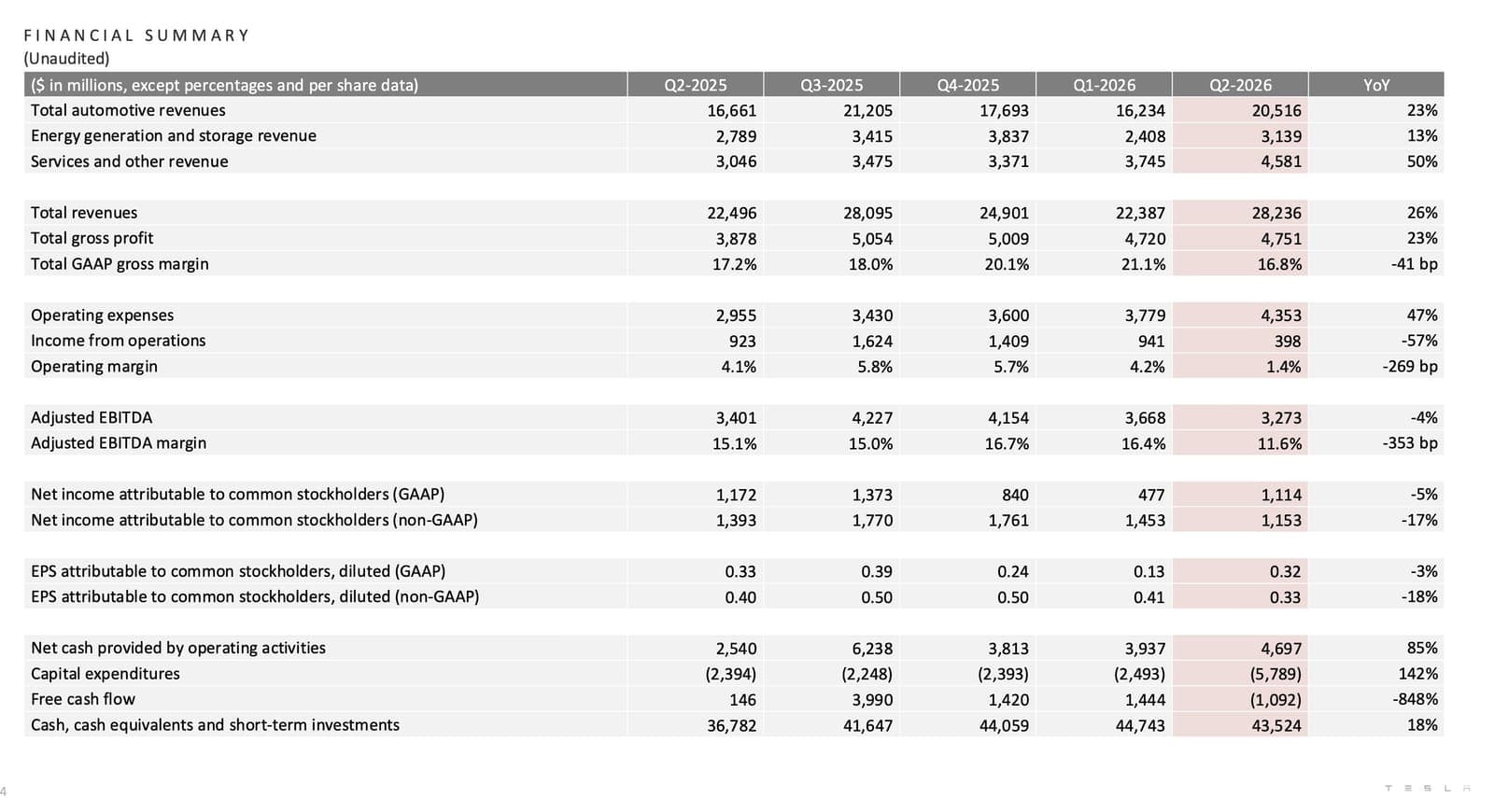
The top line looked fine. Revenue came in at $28.2 billion, ahead of Wall Street's roughly $27.6 billion estimate and up 26% from a year earlier, helped by a 50% jump in "services and other" revenue. Almost everything below that line, though, moved the wrong way.
Non-GAAP earnings per share landed at $0.33, missing the $0.55 analysts expected by a wide margin. GAAP gross margin slid to 16.8%, down from 21.1% just one quarter earlier, and operating margin nearly vanished, falling to 1.4% from 4.2% in the first quarter. GAAP net income was $1.11 billion.
The culprit isn't a mystery — it's spending. Capital expenditures more than doubled from the prior quarter to $5.79 billion, up 142% year over year, and that outlay is precisely why free cash flow swung to negative $1.09 billion even as operating cash flow actually rose 85%. Tesla is pouring money into factories, batteries and compute well ahead of the revenue those bets are meant to produce.
The software business had its best quarter ever
The clearest bright spot was subscriptions. Tesla added roughly 200,000 net new Full Self-Driving (Supervised) subscribers in the quarter — a company record — lifting the total to about 1.48 million, up 56% year over year. On average, around 2,200 customers subscribed per day, and Tesla pegged the recurring revenue run-rate of the FSD subscription business at roughly $775 million a year.
Elon Musk framed the shift in characteristically blunt terms, arguing that a growing share of buyers now think of the purchase as "Tesla FSD with a car attached, rather than the other way around." Whether or not that's literally true for most customers, it signals how central high-margin software has become to Tesla's story — especially in a quarter when hardware margins were falling.
Cybercab enters production, batteries stay the bottleneck
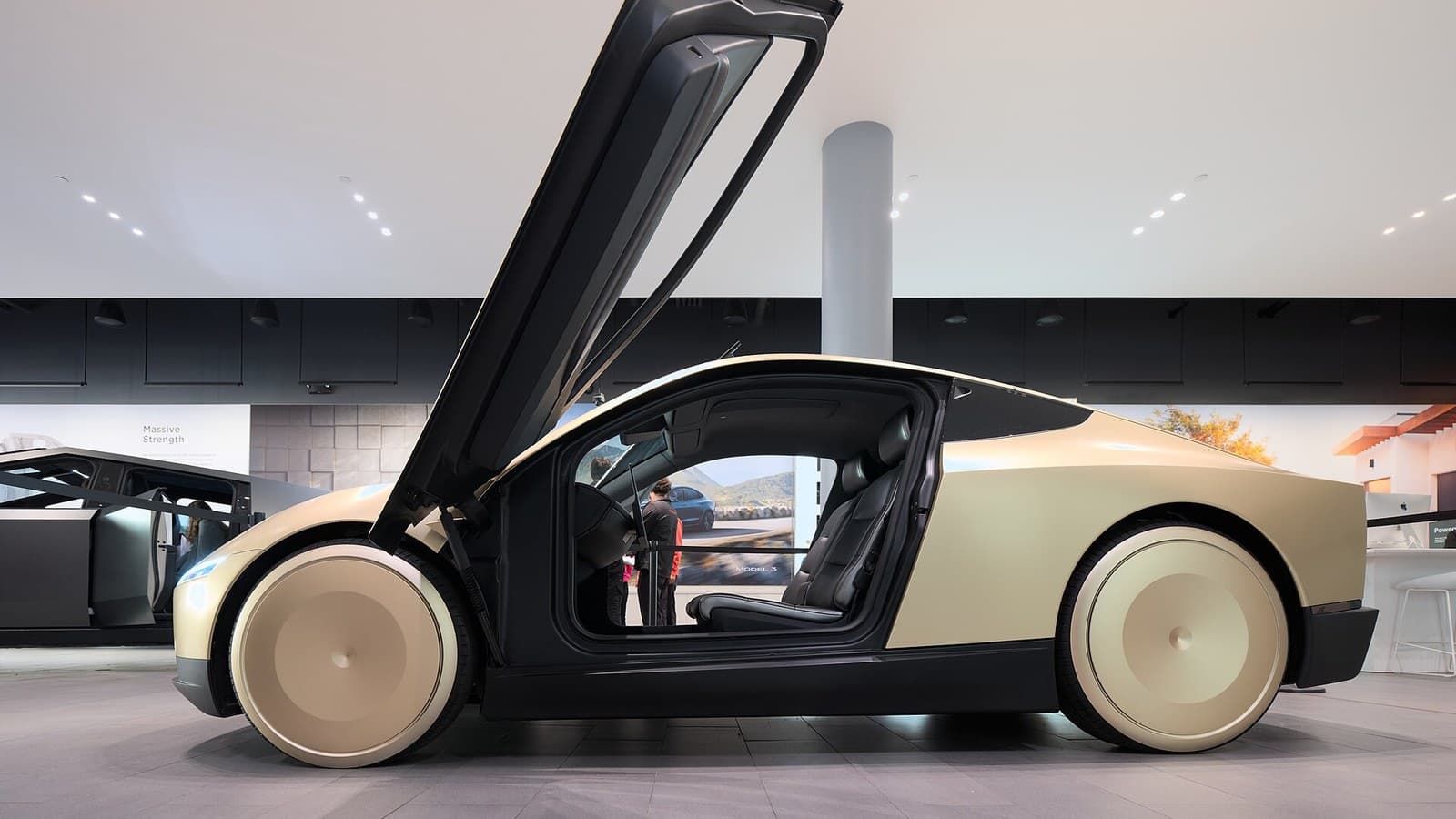
Tesla confirmed that Cybercab, its purpose-built autonomous vehicle, entered production at Gigafactory Texas, with installed annual capacity now listed at more than 125,000 units. Engineering test drives of production Cybercabs on public roads began during the quarter, and this month Tesla started giving employees rides in them on the Giga Texas campus — moves the company calls precursors to putting Cybercab into its Robotaxi fleets.
Underneath the optimism sits a constraint Tesla has flagged for several quarters running: battery pack capacity, which it again called the main limiter on near-term vehicle production. The company detailed a broad push to relieve it — more pack capacity in Berlin, cathode and lithium refining in Texas, LFP cells in Nevada, and higher 4680 cell output earmarked for Cybercab, Semi and Model Y.
Optimus moves onto the old Model S/X line
In the quarter's most symbolic update, Tesla said it has decommissioned the Model S and Model X manufacturing lines at its Fremont factory and is installing the first production lines for Optimus, its humanoid robot, in that same space, with production expected to begin "soon." The early robots won't ship to customers; they'll feed an internal effort Tesla calls the "Optimus Academy," collecting training data and refining the robot's capabilities.
Powering all of this is a fast-growing compute footprint. Tesla said it more than doubled its onsite compute capacity in Texas during the first half of the year — an effort it calls Cortex 2, supporting both vehicle autonomy and robot software — and plans to push that to nearly 400 megawatts in the back half of 2026. Musk also teased a new product called Megapod, which he described as pairing an x86 computer with Tesla's AI4 chip, essentially "digital Optimus in a giant box" that could be placed anywhere, including at Superchargers.
Robotaxi's paid miles pile up
Tesla's Robotaxi network reached 2.4 million cumulative paid miles, up from about 1.7 million at the end of the first quarter — roughly 700,000 miles added in a single quarter, more than the network had logged in its entire history before this year. The fleet is already running early versions of FSD V15, according to Autopilot software head Ashok Elluswamy.
A dose of perspective is warranted: 2.4 million Robotaxi miles is a sliver of the 7 billion-plus miles logged across Tesla's broader supervised FSD fleet, and the driverless fleet in cities like Austin, Dallas and Houston remains small in absolute vehicle count. Musk was also emphatic that Tesla won't route Robotaxi through Uber or Lyft — "we will have enough demand," he said — with riders booking directly through Tesla's own app.
The tension at the center of the quarter
Stitch it together and Q2 2026 is a quarter in which Tesla's core auto business delivered thinner margins and negative cash flow while the company simultaneously ramped spending across four capital-hungry frontiers — Cybercab, Semi, Optimus and AI compute. Tesla leaned into that framing rather than softening it, calling this its "largest and most exciting period of investment" and warning investors directly that "scaling will be non-linear."
That's an honest description of the numbers. The spending is real and already visible in the margins; the payoff from Cybercab, Optimus and a larger Robotaxi network sits mostly ahead of the company, not behind it. Whether the trade was worth it comes down to execution — whether these programs scale the way Tesla is betting they will. This report made the bet bigger and more concrete. It did not settle it.