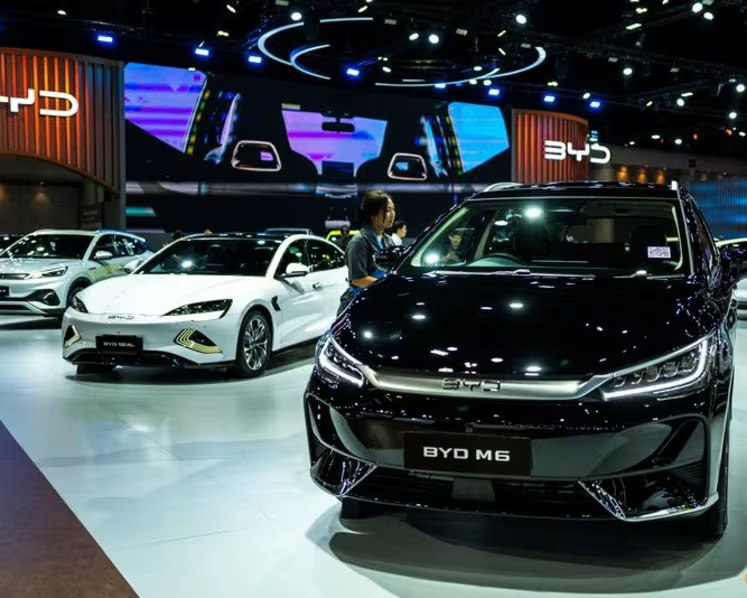
BYD sold 419,211 vehicles in July, up 21.8% year on year — a third consecutive month of growth, and the number in every headline.
Here is the number that explains it. Overseas shipments of passenger vehicles and pickups: 179,841, up 124.3%.
That is roughly 43% of everything BYD sold last month, from a company that a couple of years ago was overwhelmingly domestic.
The subtraction
If total sales rose 21.8% while exports more than doubled, the domestic business did not grow. It shrank.
The first-half figures make the scale plain. BYD sold 1.81 million vehicles worldwide in the first six months of 2026 — down about 15.7% year on year. Sales inside China fell roughly 40%, to about 1.02 million.
Domestic declines began in May 2025 and ran for eight straight months. What ended the losing streak was not a recovery at home; it was exports growing fast enough to outrun the decline.
BYD is not, at the moment, a growing company. It is a company being relocated.
Why China fell apart
Part of it is the obvious: subsidy support fading, a property slump weighing on household spending, dealer inventories running high, and a domestic price war in which every Chinese manufacturer is discounting into the same shrinking pool.
But one policy change did specific, targeted damage. From 2026, Beijing excluded plug-in hybrids with less than 100km of battery range from purchase tax subsidies entirely.
Short-range PHEVs were a BYD speciality — the affordable, high-volume products that made it the largest new-energy manufacturer in the world. Domestic plug-in hybrid deliveries fell roughly 62% year on year.
That is not a market turning against a company. That is a rule change removing the tax advantage from a specific product category, and the largest seller of that category taking the hit.
What "export growth" actually looks like
This week's UK launch is a useful specimen.
The Ti 7 is BYD's first seven-seat SUV for Britain, from £47,995. The obvious comparison is the plug-in Land Rover Defender 110, which starts around £71,840 — a gap of roughly £24,000.
The specs are not the usual budget-alternative story either. The Ti 7 makes 408PS from a 1.5-litre turbo petrol engine and three motors, does 0–62mph in 4.8 seconds, and offers up to 74 miles of electric range against the Defender's 31.1. It has a 15.6-inch screen, dual 50W wireless chargers, and a built-in fridge that also warms food.
Deliveries start January 2027. Order with a £500 deposit and BYD matches it.
Undercutting a premium badge by a third is one strategy. Undercutting it by a third while beating it on the metric that defines the category is a different one.
The arithmetic problem
BYD is guiding to 5.0–5.5 million new energy vehicles for 2026, with an export target of 1.5 million — raised from 1.3 million in January, against 1.05 million actually exported in 2025.
Roughly 2.23 million vehicles have been sold through July. Five months remain. Reaching even the bottom of the range would require averaging well above July's pace for the rest of the year — a substantial acceleration, not a continuation.
The export target looks achievable. The total does not, on current running.
What to watch
Whether Chinese domestic sales stabilise now that the PHEV subsidy change has been in effect for a full year of comparisons, and whether Europe absorbs BYD's volume without a tariff response. Exports are currently carrying the company. That works until a border decides it shouldn't.