It happened at 2:25 in the afternoon.
Not at night. Not in fog. On a clear Monday afternoon on the northbound Golden State (5) Freeway at Roxford Street in Sylmar, just north of the 405 transition, an SUV drove into the back of a semi-truck that was not moving.
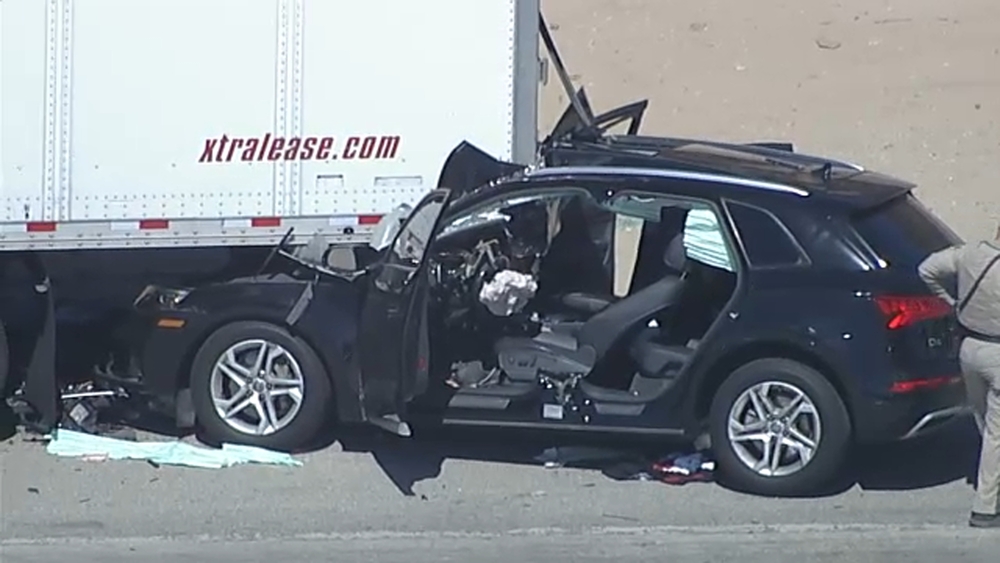
CHP says the driver appeared to be travelling on the right shoulder. Aerial footage showed the black SUV pinned beneath the trailer's rear corner — which had come through the windshield. The airbags had fired. One person was trapped inside and had to be cut out. Crews at the scene described the injuries as critical.
ABC7 identified the vehicle as an Audi SUV.
What the photograph shows
The image above is the reason anyone should care about this crash beyond the traffic delay.
Everything forward of the windshield is gone. Not crushed — gone. The hood, the front bumper, the crash structure, the entire engine bay have been sheared off the car and left on the asphalt. The engine itself is sitting where the front passenger's legs were. The A-pillar is folded back. The roof has peeled.
And then, roughly at the B-pillar, it stops. The rear doors are intact. The rear seats are unmarked. The tailgate is closed and undamaged.
That line — where total destruction becomes an ordinary parked car — is the entire story of this crash type. It is called underride, and it is what happens when a passenger vehicle goes beneath something taller than it. The car's crumple zones never engage, because there is nothing in front of them to crumple against. The trailer's floor passes over the hood at roughly the height of a driver's head, and the first thing that stops the vehicle is the occupant compartment.
Modern cars are extraordinarily good at absorbing a frontal impact. They cannot absorb an impact that goes over the top of them.
The trailer is an XTRA Lease unit, one of the largest trailer-leasing fleets in the country. Federal rules require trailers to carry a rear impact guard — the horizontal steel bar below the doors, mandated precisely to keep cars out from underneath. The condition and performance of that guard is one of the things CHP's investigation should establish, and nothing about it has been released.
The Insurance Institute for Highway Safety has spent years pushing for stronger rear guards and for side underride guards, which remain unmandated in the United States. This crash is the exact scenario those campaigns are about.
Fifteen months ago, the same crash at the same exit killed two people
On May 29, 2025, at 10:41 p.m., a dark SUV rear-ended a semi parked on the shoulder of the northbound 5 near the same Roxford Street exit. The vehicle caught fire. A 40-year-old man and a 30-year-old woman died.
Same freeway. Same exit. Same failure: a moving vehicle into the back of a stationary truck.
One in darkness, one in daylight. The daylight one is the more damning of the two, because it removes the excuse.
Why the trim is the question nobody is asking
Here is the detail that will determine what this crash actually means, and no one has released it: which Audi, and which trim.
On modern Audis, the crash-avoidance suite is not standard equipment across the range. Forward collision warning, automatic emergency braking, adaptive cruise assist and lane guidance are distributed across trim levels and optional driver-assistance packages. Two cars of the same model year, same badge, same showroom can have materially different ability to see a stopped truck.
So the questions that matter are:
- What model and trim was it?
- Was a driver-assistance package fitted?
- Was any of it switched on?
- Did it warn, brake, or do nothing?
The aerial footage is not sharp enough to read the model badge on the tailgate, and neither CHP nor any outlet has released it. Until somebody does, this is a crash with no explanation attached. And the answer decides whether this was a car that had no help to give — or one that had it and it did not work.
The human eye is badly designed for this exact crash
There is a reason stopped vehicles kill people out of proportion to how often you encounter them.
Human hazard detection runs on looming — the rate at which an object expands across your visual field. It is superb for something moving toward you. It is close to useless for something standing still.
Approach a parked trailer at 65 mph and, for most of the approach, it barely grows. The expansion is slow, then sudden. By the time your visual system flags it as a threat, you are inside the distance you need. This is not carelessness; it is the hardware. It is the same reason highway workers, tow operators and police officers are killed on shoulders every year, and the reason every state has a Move Over law that drivers still fail to obey.
Add the ordinary conditions of a Monday afternoon commute — a glance at a phone, a slow drift toward the shoulder line, fatigue after a long haul north out of the Valley — and the margin is gone.
A human being at freeway speed has roughly one and a half seconds of usable reaction time. That is the whole system. That is what we license people on.
This is precisely the problem autonomy exists to solve
36,640 people died on American roads in 2025 by NHTSA's estimate. That was a good year — down 6.7 percent from 39,254 in 2024, and the second-lowest fatality rate ever recorded per mile driven.
Thirty-six thousand people. In the best year in a decade.
Machines do not have a looming problem. A camera-and-radar stack measures distance and closing rate directly. It does not need an object to grow in a visual field to know it is there and that you are going to hit it. It does not get tired at the end of a shift, does not look down at a text, does not drift onto a shoulder because it has driven that stretch four hundred times.
That is the entire premise of automatic emergency braking, of Audi's own pre-sense systems, of Tesla's Full Self-Driving and every supervised driver-assistance stack being built by every manufacturer. These systems exist to catch exactly the crash that happened at Roxford Street on Monday afternoon — and the one that happened there fifteen months earlier.
The industry did not pick this problem at random. It picked it because it is the one humans are worst at, and because it is the one that fills trauma bays.
The honest part: the work is not finished
It would be dishonest to pretend the technology has already solved this, and readers deserve the real picture.
The stationary-object case is the hardest problem in the field, for machines as well as people. Radar can struggle to distinguish a stopped truck from an overhead sign or a manhole cover, so systems have historically been tuned to discount stationary returns — which is why driver-assist vehicles have repeatedly struck parked emergency vehicles.
NHTSA has open work on exactly this. In December 2025 it opened a preliminary evaluation, PE25012, after 58 complaints describing Tesla FSD encountering stationary and emergency vehicles. In March 2026 it escalated a separate probe to Engineering Analysis EA26002, covering roughly 3.2 million vehicles, over nine crashes in reduced visibility including one fatality.
None of that is an argument against the project. It is an argument that the project is not done, and that supervised systems are supervised for a reason — the driver is still the backstop.
But note what the alternative is. The alternative is the status quo, and the status quo is a person with a second and a half, an eye that cannot see stopped objects, and 36,640 bodies a year.
What we still do not know
The model and trim of the Audi. What driver-assistance equipment it carried and whether it was active. Why the SUV was on the shoulder. Whether the driver had a medical event. Why a semi was stopped there at all, and whether it was legally positioned and lit.
CHP's investigation is ongoing and none of the above is established. This report does not assign fault to the driver, the truck operator, or the vehicle.
What is established is the geometry: a stationary object, a moving car, a clear afternoon, and a trailer corner where a windshield should have been. That is a solvable problem. It is just not solved yet.
This is a developing story. The driver's condition, the cause of the collision and the vehicle's specification have not been released. CHP's investigation is ongoing.