The 2026 Orionid meteor shower peaks before dawn on October 21 and 22. The best time to photograph it is after the Moon sets, around 2 to 3 a.m. local time, until first light. Use a wide lens on a tripod at around f/2.8, ISO 1600 to 3200, with 15 to 20 second exposures fired back to back.
The Orionids are debris from Halley's Comet. They're fast, often leave glowing trails, and produce about 10 to 20 meteors an hour under dark skies. For the rest of the season's showers, see our 2026 meteor shower calendar.
Orionids 2026 at a glance
| Orionids 2026 | |
|---|---|
| Peak | Pre-dawn Oct. 21–22 (EarthSky: 18:00 UTC Oct. 21) |
| Active | Early October to early/mid-November |
| Rate | About 10–20 per hour under dark skies |
| Moon | Waxing gibbous, about 74–80% lit; sets about 2–3 a.m. |
| Radiant | Near Orion's raised club, above Betelgeuse |
| Speed | About 41 miles (66 km) per second |
| Parent | Halley's Comet |
What time should I go out?
Orion rises before midnight but is highest around 5 to 6 a.m. The Moon sets around 2 to 3 a.m., which opens a dark window of roughly three to three and a half hours before dawn. Space.com suggests starting at about 2 a.m.
What gear do I need?
- Camera with manual mode (mirrorless or DSLR)
- Wide, fast lens: 14 to 24mm on full frame, at f/1.4 to f/2.8
- Sturdy tripod
- Intervalometer or built-in interval timer
- Spare batteries, since cold drains them fast
- Lens heater or hand warmers to stop dew forming
What camera settings work best?
| Setting | Starting point |
|---|---|
| Mode | Manual |
| Aperture | Widest (f/1.8–f/2.8) |
| ISO | 1600–3200 (lower near cities) |
| Shutter | 10–20 sec; shorten if stars trail |
| Focus | Manual, magnified on a bright star |
| White balance | About 3800–4200K |
| File type | Raw |
| Drive | Continuous intervals, 1–2 sec gap |
| Stabilization | Off on a tripod |
The "500 rule" is a quick check: divide 500 by your focal length (times your crop factor) to get the longest exposure before stars smear. At 20mm on full frame, that's about 25 seconds. Many photographers go shorter for sharper stars on high-resolution sensors.
How do I photograph meteors with a phone?
- Mount the phone on a tripod. Don't hand-hold it.
- Use Night mode at its longest setting, or a Pro/Expert RAW mode with a 10 to 30 second shutter.
- Turn the flash off and tap to focus on a bright star or distant light.
- Shoot continuously. Some apps offer interval or timelapse modes.
Phones record only the brighter meteors, so set your expectations accordingly.
How do I make a meteor composite?
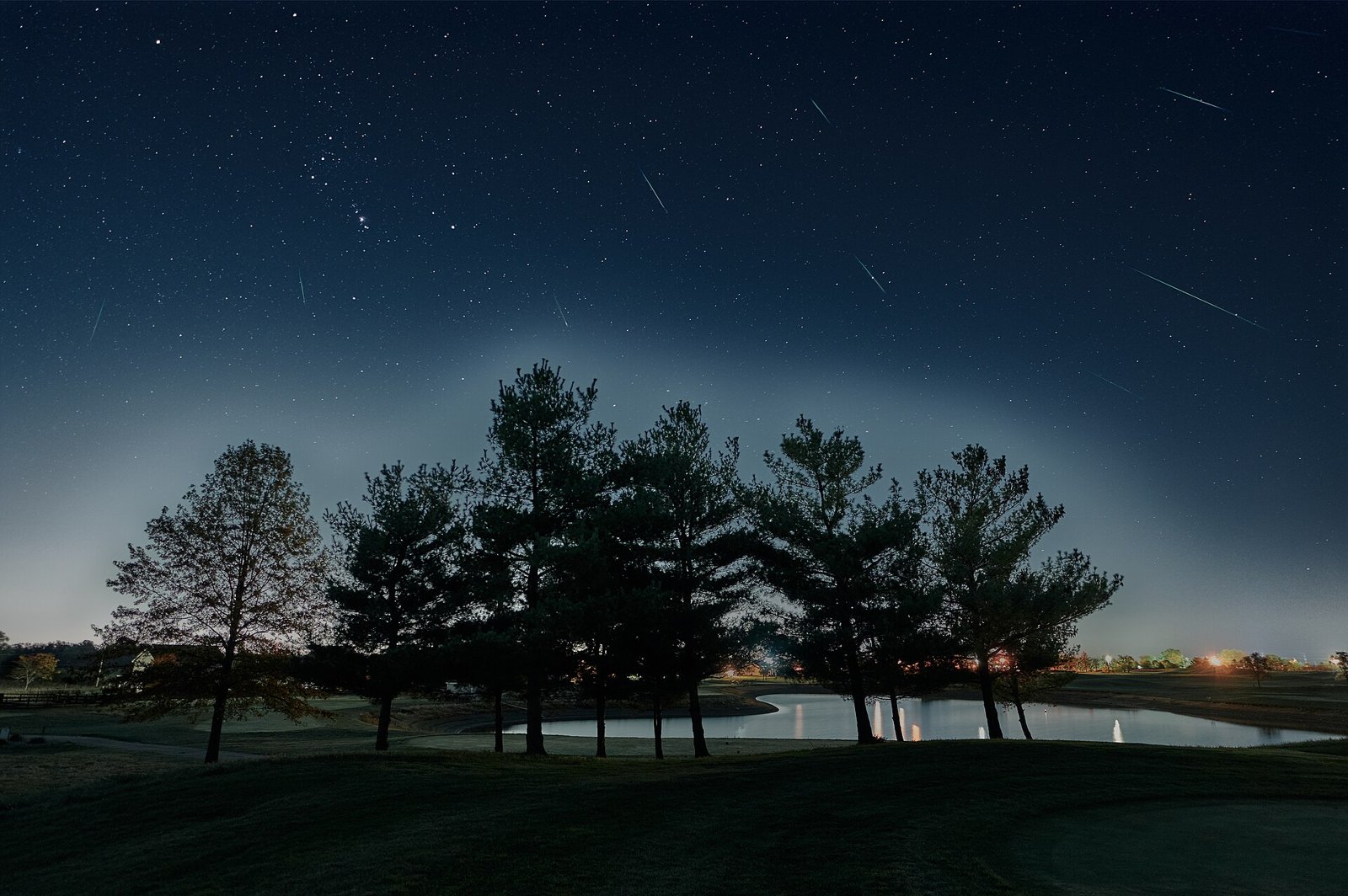
The striking images showing dozens of meteors are usually composites. Shoot hundreds of frames, pick the ones with meteors, and layer them over a single clean sky frame in editing software, aligning the stars. Shooting the foreground separately, as the photographer of our lead image did, gives a cleaner landscape.