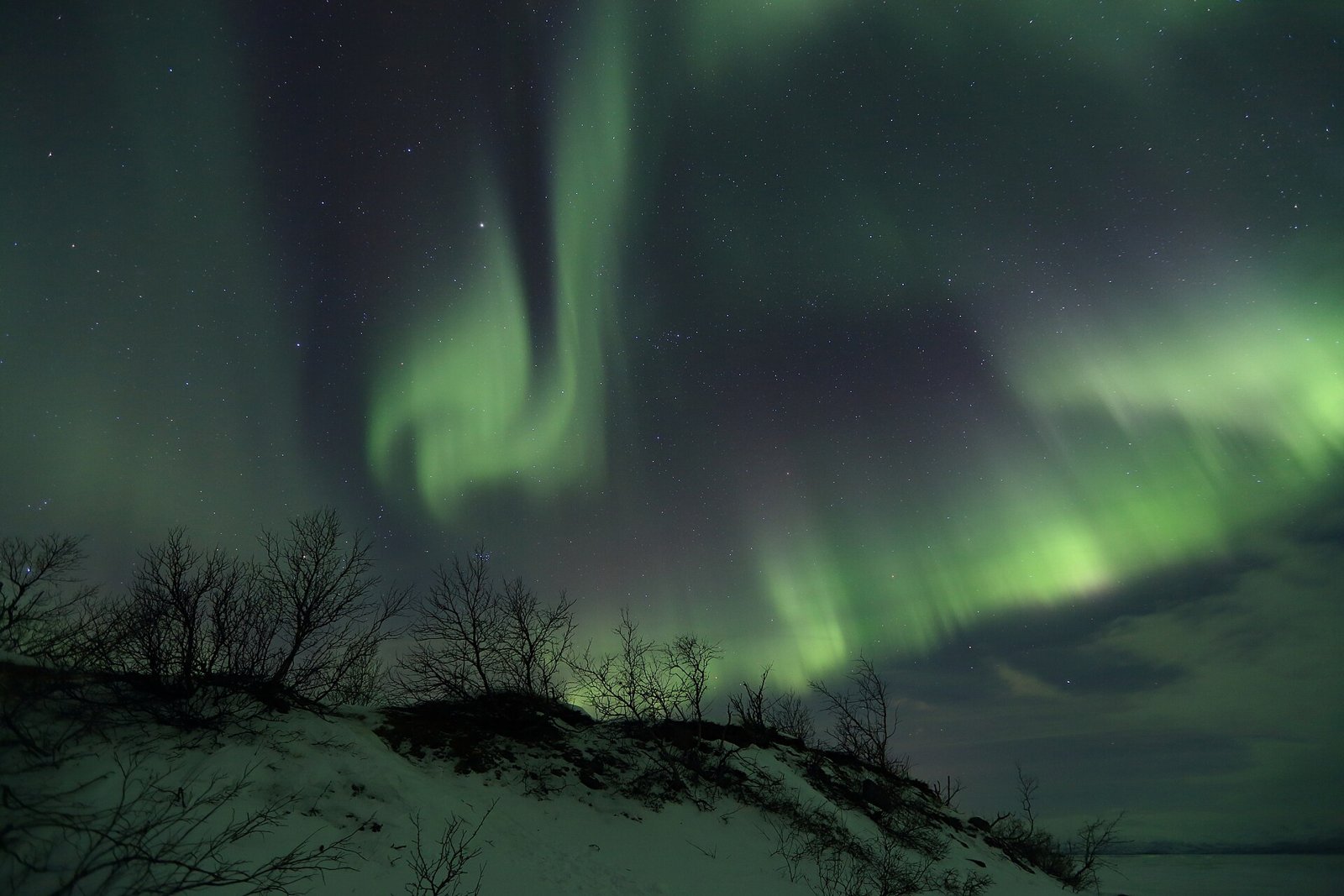
To photograph the northern lights, put your camera on a tripod, use a wide lens at f/1.8 to f/2.8, set ISO 1600 to 3200, and start with 2 to 10 second exposures. Face north from a dark spot. NOAA says displays are usually best between about 10 p.m. and 2 a.m.
Phones can work too. Night mode often captures colors your eyes can't see. Below is a full settings cheat sheet, plus how to read the Kp index so you know when it's worth going out. If you're already outside for the aurora, the Orionid meteor shower peaks Oct. 21–22.
Northern lights camera settings cheat sheet
| Setting | Faint aurora | Bright, fast aurora |
|---|---|---|
| Mode | Manual | Manual |
| Aperture | Widest (f/1.4–f/2.8) | f/2–f/2.8 |
| ISO | 3200–6400 | 800–1600 |
| Shutter | 8–15 sec | 1–5 sec |
| Focus | Manual, on a bright star | Manual, on a bright star |
| White balance | About 3500–4000K | About 3500–4000K |
| Format | Raw | Raw |
| Stabilization | Off on a tripod | Off on a tripod |
Shorter shutter speeds preserve the aurora's ribbons and "pillars." Long exposures blur them into a smooth green glow.
What does the Kp index mean?
The Kp index measures geomagnetic activity from 0 to 9. NOAA's rough guide:
| Kp | What to expect |
|---|---|
| 0–2 | Aurora stays far north and dim |
| 3–5 | Brighter, more active; good from high-latitude spots |
| 6–7 | May be visible from the northern edge of the U.S. |
| 8–9 | Can be overhead in northern U.S. states |
NOAA notes that Kp maps show the southernmost place aurora may be seen, often hundreds of kilometers from where it actually is.
How do you photograph the aurora with a phone?
- Steady the phone on a tripod or a solid surface.
- Turn off the flash.
- Use Night mode and choose the longest exposure, or a Pro/RAW mode with a 3 to 10 second shutter and ISO 800 to 3200.
- Tap to focus on a bright star or distant light.
- Shoot anyway. Camera sensors often record green and red that look gray to your eyes.
When and where should you go?
- Get away from city lights and find a clear view of the northern horizon. NOAA suggests a hilltop.
- Go near local midnight, or earlier during strong storms.
- Equinox months (September–October and March–April) tend to bring larger storms.
- Avoid summer at high latitudes, when it may never get properly dark.
What gear should you pack?
- Wide, fast lens (14–24mm full frame)
- Tripod and remote release or self-timer
- Spare batteries kept warm in a pocket
- Headlamp with a red-light mode
- Hand warmers to keep dew off the lens