A magnitude 7.4 earthquake struck western Colombia on Monday, at a depth of about 107 kilometres, with an epicentre in Chocó Department roughly 20km from San José del Palmar — a town of about 4,800 people, some 250 miles west of Bogotá.
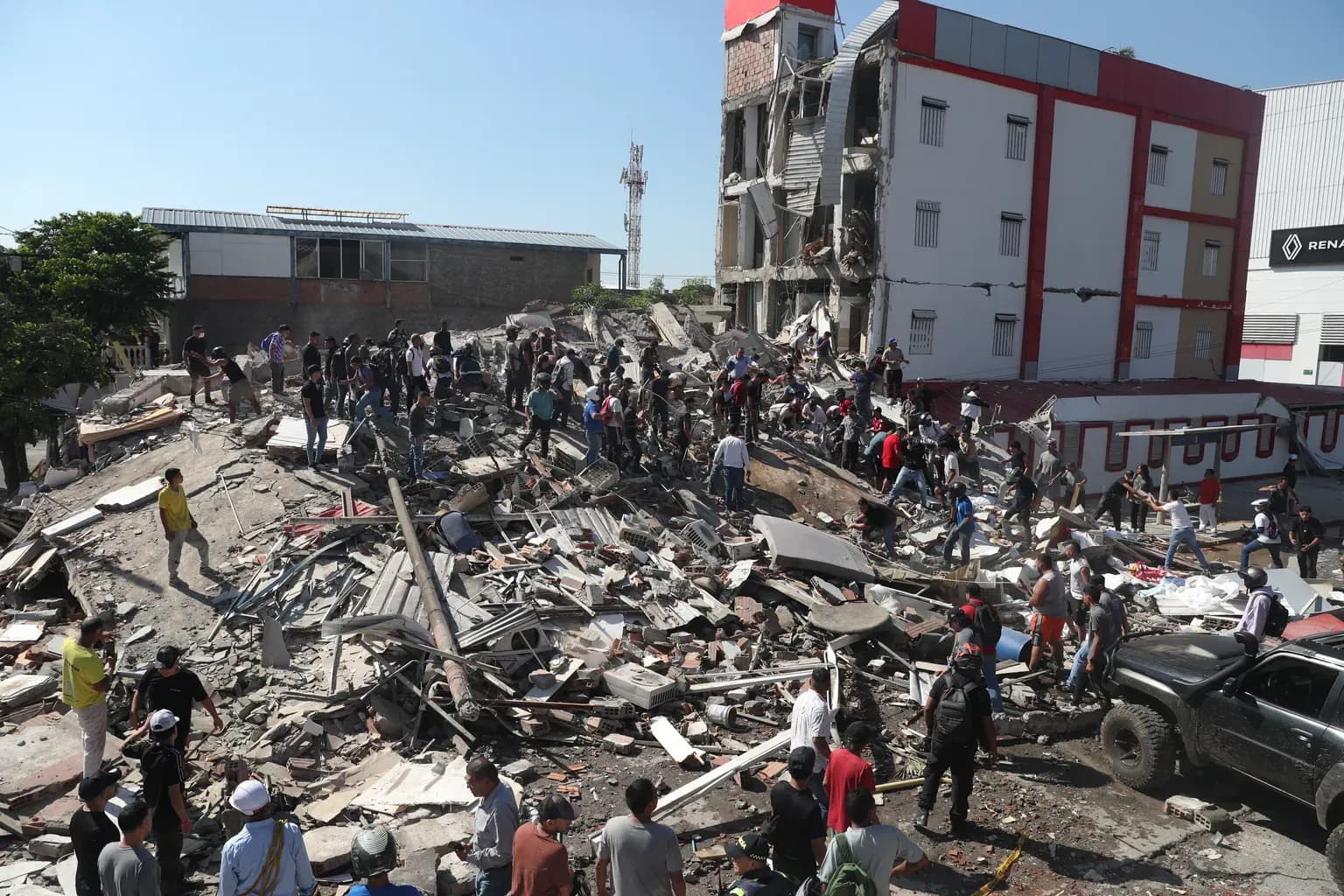
Buildings came down across western Colombia, including in Cali. The shaking was felt in Ecuador and Panama. Colombia has declared a state of national disaster.
Read the numbers as a floor
In the first hours the reported death toll moved from at least 20, to 47, to 77, to at least 80.
That is not confusion in the reporting. It is what the early hours of a major earthquake look like: rescue crews reach a collapsed structure, and the count changes. People remain trapped.
The figure that should frame this story is not any of those. It is the US Geological Survey's assessment that there is roughly a one-in-three chance the eventual death toll exceeds 1,000.
The USGS produces that estimate automatically, by modelling the shaking against local population density and building stock. It is a probability, not a forecast, and it is frequently wrong in both directions. But it is the only currently available number that describes the scale of the event rather than the progress of the search.
Anyone reading a toll tonight is reading how far rescuers have got, not how many people were hurt.
Why 107 kilometres matters
Most destructive earthquakes are shallow. The Kumamoto quake that hit Japan two weeks ago was about 10km deep.
This one ruptured more than ten times deeper. Depth changes the shape of a disaster in two ways.
It widens the area affected, because energy radiating from 107km down reaches the surface across a far larger footprint. That is why this was felt in three countries and why evacuations followed in Ecuador as well as Colombia.
It usually reduces the peak violence directly above the rupture, because the energy has further to travel and disperses on the way.
Which makes the collapses the important detail. A deep magnitude 7.4 that still brought down buildings across multiple cities indicates either very severe shaking, vulnerable construction, or both — and that question is what will determine the final toll.
Where this happened
Chocó is one of Colombia's poorest and least accessible departments — heavily forested, poorly served by roads, on the Pacific coast. San José del Palmar is a community of a few thousand people.
The practical consequence is that the places closest to the epicentre are the hardest to reach, and the reporting so far is coming disproportionately from Cali, a city of more than two million, because that is where the cameras and the hospitals are.
It is likely to be some time before anyone can describe what happened in the towns nearest the rupture. In earthquakes of this kind, that gap is frequently where the worst of it turns out to have been.
Update, Monday evening: 132 dead, and the epicentre is not where they died
The toll reached at least 132 by Monday night, and the distribution was immediately the story: the deaths were concentrated in Cali and in Risaralda, where Pereira is — cities in the Cauca valley and the coffee belt, well east of San José del Palmar. Chocó, the department containing the epicentre, reported a small fraction of them.
That is exactly what a 107-kilometre-deep earthquake does. Energy released that far down does not punch a hole in the surface above it; it radiates outward and arrives across an enormous footprint. The town nearest the epicentre was, in a sense, in a better position than a mid-rise apartment block a hundred kilometres away.
The caveat matters as much as the finding: Chocó is hard to reach, and its low count reflects road access as much as damage. That has already begun to correct — see below.
A magnitude 5.0 aftershock followed roughly an hour after the main quake. Cali's mayor, Alejandro Eder, reported about 30 collapsed structures across the city of two million.
Update, Tuesday: the number that matters now is 2,700
The confirmed death toll is at least 132. The number to hold alongside it is this one: more than 2,700 people have been reported missing.
That figure needs its caveat stated up front, because it will be misused. It comes from citizen-run websites where families post the names of people they cannot reach — not from a government register, and not from anyone's confirmed list. In every disaster of this kind, most of the names on such a list turn out to be people whose phones died, who walked to a relative's house, or who were logged twice.
But the number is not meaningless either. It is a measure of how many households in western Colombia spent Monday night unable to account for someone, and it is the single best available indication that 132 is nowhere near the end of this.
The revised breakdown
Our earlier figures have been superseded. Al Jazeera's departmental accounting now runs: 35 killed in Cali, at least 40 in Risaralda, where Pereira is, nine in Chocó, two in Caldas and one 73-year-old in Antioquia. President de la Espriella separately reported 700 injured in Valle del Cauca alone, against an earlier national figure of 87.
The pattern from Monday holds — the deaths are concentrated well east of the rupture — but Chocó's count has more than doubled, and that is the direction it is likely to keep moving.
Nobody has reached the epicentre
Two days on, San José del Palmar has not been properly assessed.
Chocó is 200km west of Cali and Pereira, and much of it is reachable only by boat or plane. Colombia has now sent engineers, rescue crews and search dogs toward it, but the roads that would carry heavy equipment largely do not exist, and the airports that would fly it in are among the six closed for structural inspection.
So the entire national picture — 132 dead, the departmental table, the missing list — is a picture of the places that could be reached. The 4,800 people nearest the rupture are not yet in it.
The hospital, and the 600 people in the street
Several upper floors of a Cali hospital, some of them given over to pediatric care, pancaked onto the floors beneath them. Patients were trapped inside.
The consequence, described by hospital director Irne Torres Castro to Caracol television, is the detail that stays with you: about 600 patients were moved out and treated on a street strewn with rubble.
A hospital is the one building a city cannot lose on a day like Monday, and Cali lost most of one at the moment its emergency rooms filled. Hospitals in five cities are on red alert. The question of why that structure failed — what year, what code, whether anyone had flagged it — is the one most likely to be dropped once the digging stops, and the one that will decide whether this happens again.
Curfews, looting, and 1,000 troops
Cali, Pereira, Armenia and Manizales imposed nighttime curfews on Monday. After reports of looting, de la Espriella ordered roughly 1,000 members of the security forces into Cali by dawn and said the government had mobilised the "entire military and police apparatus."
Six airports — Pereira, Manizales, Quibdó, Armenia, Cartago and Buenaventura — were suspended for structural inspection. The towers of a historic cathedral in Manizales were damaged. The International Rescue Committee's Camila Gomez said roughly 50 education facilities have been affected. Cali's Petronio Álvarez Music Festival, due to open Wednesday, was postponed, along with professional football.
Colombia's Geological Service logged 21 aftershocks by late Monday and warned of more.
The president has been in office three days
Abelardo de la Espriella assumed power on Friday. The earthquake was Monday.
That is worth stating without editorialising in either direction. A new administration has not yet staffed its agencies, does not know its own emergency machinery, and has no track record for anyone to rely on — and it is now running the response to the strongest earthquake Colombia has recorded this century. Whatever anyone thinks of the politics that put him there, the operational reality is a government three days old.
He has visited Quibdó and Cali, promised rental subsidies for people whose homes were destroyed, and framed the response in non-partisan terms: "Here, there are no distinctions or ideological divisions when it comes to defending our people."
Who is helping
The United States announced $15.5 million in emergency assistance for shelter and food; Secretary of State Marco Rubio said Washington was monitoring the situation. The European Union activated the Copernicus satellite service to map damage for rescue teams. El Salvador's Nayib Bukele and Mexico's Claudia Sheinbaum both offered rescue teams and medical personnel.
Update, August 17: the search is over, and the shape of the disaster has changed
A week on, Colombia's National Unit for Disaster Risk Management put Saturday's official count at:
| Confirmed dead | 294 |
| Injured | 3,935 |
| Unaccounted for | 320 |
The search for survivors has effectively ended and the operation has shifted to recovery. The 72-hour window in which almost all earthquake survivors are found closed on Thursday.
The missing list resolved, as these usually do
On August 11 we reported more than 2,700 people listed as missing on citizen-run websites, and said plainly that the figure was not official, that most such names historically resolve safely, and that it should not be read as a projected death toll.
It has come down to 320. That is the ordinary and welcome pattern, and it is worth stating explicitly because a number that large, published without its caveat, does real damage to families reading it.
The USGS projection now looks like an overshoot
The frame of our first report was the USGS assessment of a roughly one-in-three chance the toll would exceed 1,000. At 294 confirmed with 320 unaccounted for, even the worst arithmetic lands near 600.
That model appears to have overshot, which is what a one-in-three probability is entitled to do. It was still the right number to publish on day one — it described the possible scale when nothing else could — and it is worth going back and marking when it turns out to be wrong.
Two-thirds of the deaths are in two cities
The finding we led with on August 11 is now settled, and it is starker than we put it: more than two-thirds of all fatalities are concentrated in just two cities — Cali and Pereira.
Both are roughly a hundred kilometres from the epicentre.
This is the signature of a deep earthquake. The rupture at 96 to 107 kilometres down did not destroy the ground above it; it radiated outward and found the places with the most people and the most mid-rise concrete. San José del Palmar, directly above it, is not where most of the dying happened.
(A note on the depth: the USGS put it at about 107km, Colombia's own geological service at about 96km. Both describe the same intermediate-depth event.)
The revision nobody has headlined
Here is the number that changed most, and it changed in the direction of good news in a way that makes the disaster worse.
Engineering teams completing their reviews this week cut the count of fully collapsed buildings from more than 170 to 66.
In the same assessment, destroyed homes rose above 12,500 and damaged homes above 80,000.
Read those together and the character of this event inverts. It is not primarily a collapse disaster. Comparatively few buildings came down completely — which is a quiet vindication of Colombian construction standards in the coffee belt, and the reason 294 is not 1,000.
It is a mass displacement disaster. Tens of thousands of homes are standing but unlivable, and the people in them are the story for the next two years, long after the cameras leave.
Also out of service: five regional airports, a pedestrian bridge and roughly 20 road bridges.
What the new government has done
Abelardo de la Espriella had been president for three days when the earthquake struck. He has since declared a national emergency, an economic emergency, and three days of national mourning — flags at half-staff at government buildings and at Colombian embassies worldwide.
His administration has announced rental assistance for displaced families, suspended utility and tax obligations in the hardest-hit zones, and reached an agreement with private construction firms, backed by a new reconstruction fund, to rebuild hospitals, schools and homes.
Touring Pereira, Dosquebradas, Manizales and Armenia, he called the destruction in Pereira "apocalyptic."
Interior Minister Rodrigo Lara said the hospital network in Buenaventura was overwhelmed. Colombia's seismic agency had logged more than 250 aftershocks by Friday evening.
Who is helping now
- United States: $15.5 million, then a further $11 million on August 14 — $26.5 million total, plus a disaster response team
- European Union: roughly €2 million in humanitarian funding alongside Copernicus satellite mapping
- El Salvador: roughly 100 tons of supplies across two aircraft
- Mexico: assistance offered by President Claudia Sheinbaum
Vetted routes for donations include the Colombian Red Cross, GlobalGiving's Colombia Earthquake Relief Fund, and Direct Relief, which is supplying medicine and field kits to health workers in Chocó and Valle del Cauca.
What to watch
The 320 still unaccounted for, and how many of those names resolve. What the engineering reviews conclude about the Cali hospital, whose pediatric floors pancaked — because that remains the single question with a named party attached to it. And whether the rental assistance and the reconstruction fund survive contact with the eighty thousand damaged homes they are meant to cover.
Colombia's geological service describes this as the country's strongest earthquake in a decade and its most powerful since the 1979 quake near Tumaco.
This is a developing story. Casualty figures, the depth and magnitude estimate, and the extent of damage are all subject to revision.