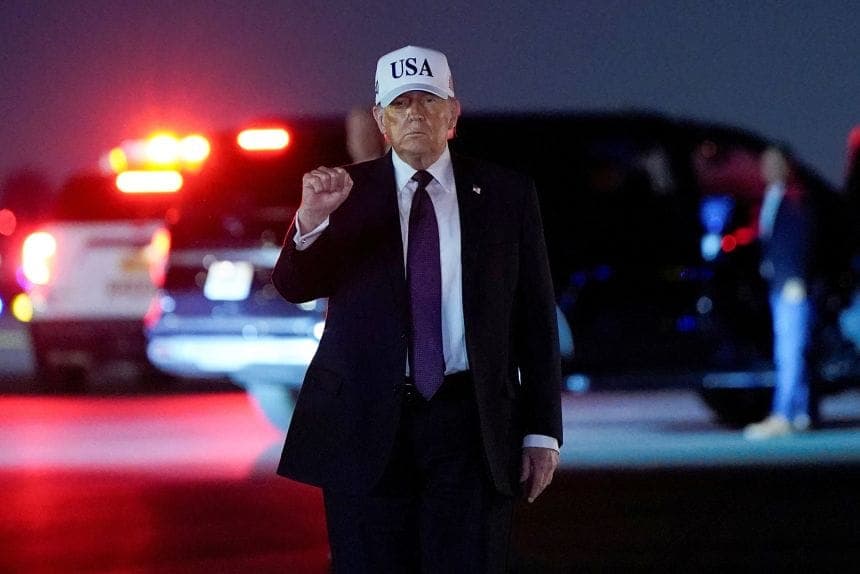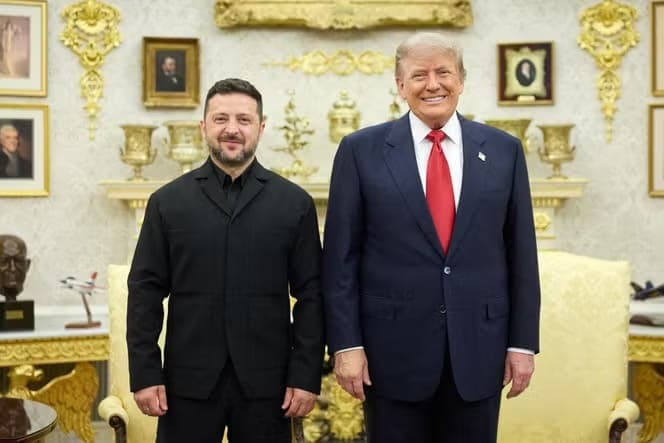
Volodymyr Zelensky was in the Oval Office at 9:30 a.m. on Tuesday. Benjamin Netanyahu was in at 11. At 2 p.m., Trump was at Washington National Cathedral eulogizing Senator Lindsey Graham.
Three appointments, two wars, and one funeral that matters more to Ukraine than the schedule suggests.
What was agreed, and what was asked for
Zelensky left calling it a "good meeting with President Trump in the Oval Office," thanking him "for all that we are doing together to protect the lives of Ukrainians and achieve peace." The talks were closed-door and covered, per both sides, ways for Ukraine to produce its own weapons and "other ideas that could help."
Trump said the US will help Ukraine produce Patriot interceptors, and that Ukraine would be able to make them "pretty quickly."
Here is the gap that keeps reappearing in this relationship.
At the NATO summit in Ankara earlier this month, Trump said: "We'll give them the right to make Patriots. We'll show them how to do it."
What Zelensky said at that same summit: "We need to find a way to get as quick as possible, as much as possible, missiles for Patriot systems. This is the most important thing."
A licence to manufacture and a delivery of interceptors are different things on completely different clocks. Standing up production of a precision air-defence missile is a multi-year industrial undertaking involving tooling, supply chains, certification and skilled labour — in a country under sustained aerial attack. Interceptors are consumed nightly.
Ukraine has been offered the ability to eventually make what it needs tonight. That is not nothing — it is a durable answer rather than a temporary one — but it does not intercept anything this winter.
The trade Ukraine is proposing
This is the part that makes the visit more than another request for help.
Ukraine now has something the United States genuinely wants: drone and counter-drone technology developed under combat conditions, at a scale and iteration speed no peacetime defence programme has matched. Zelensky came pitching it.
Trump has already signalled interest. At the summit he said: "Well, we would buy their drones, and we make drones, we make great drones, but they have an ability to make a lot of them." He did not commit.
That reframes the relationship from aid to exchange, which is the footing Zelensky has been trying to reach since 2025 — and the footing on which this administration is most likely to say yes. Reporting described a bipartisan hero's welcome for him in Washington, a sharp contrast with the confrontational Oval Office meeting of February 2025.
The wars are converging
The scheduling is not incidental. Netanyahu followed Zelensky into the same office on a day when the US–Iran conflict is in a fragile pause, with both governments giving contradictory accounts of why the strikes stopped.
Ukraine's argument to Washington has always partly been about attention and inventory: interceptors sent to one theatre are not available in another, and a president managing an active war with Iran has finite capacity for a second one. Kyiv is competing for both.
Why Graham's funeral matters here
Lindsey Graham died this month at 71 of an aortic dissection. Trump eulogized him as "a true American original." Senate Majority Leader John Thune and Vice President JD Vance also spoke. Zelensky attended.
Graham was among the most forceful Republican advocates for arming Ukraine and sanctioning Russia — the voice that made continued support legible to a Republican Senate that has grown steadily less interested in it. His death removes Kyiv's loudest ally inside the president's own party at the exact moment Zelensky is asking that party for more.
Zelensky's presence at the cathedral was diplomacy as much as mourning. There is no obvious successor to the role Graham played.
What to watch
Whether "help Ukraine produce Patriots" acquires a timeline, a site and a number. Whether the drone purchase Trump has twice floated becomes a contract. And who in the Senate picks up the argument Graham was making.
This is a developing story.