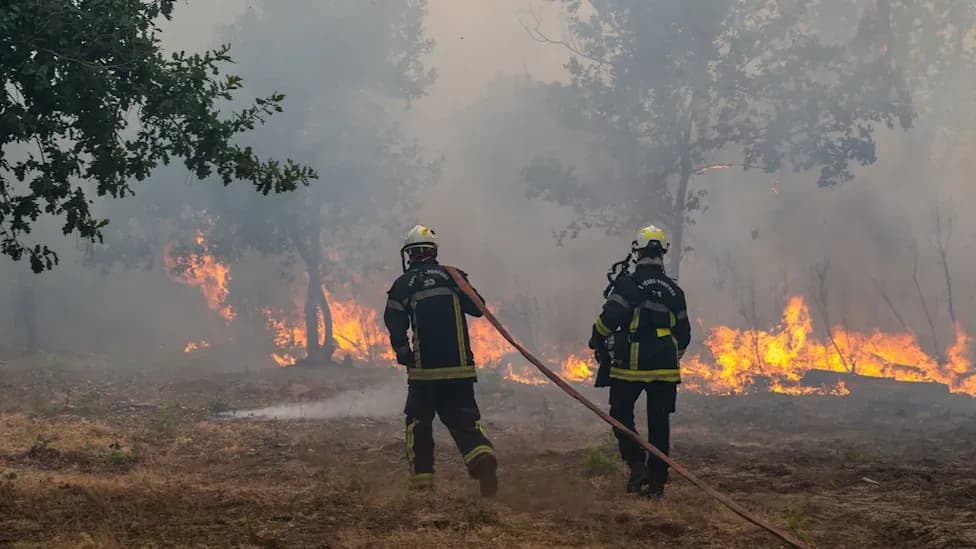
The wildfire burning north of Bordeaux has consumed roughly 42,000 hectares — nearly 104,000 acres — and is now within 15 kilometres of the city. More than 360,000 people have left their homes across France and Spain.
It has also started generating its own weather, which is the detail that explains why the response has been so difficult.
The fire cloud
The Gironde blaze has produced a pyrocumulonimbus: a thunderstorm cloud formed by the fire's own heat plume.
These are rare. They matter because they invert the usual relationship between weather and fire. A pyrocumulonimbus generates its own winds and whirlwinds, and can throw lightning that ignites new fires ahead of the front. Officials describing the fire as "erratic and unmanageable" are not reaching for drama — they are describing a fire that is no longer simply reacting to conditions but partly setting them.
That is why containment lines keep failing and why the direction of spread has been so hard to predict.
The numbers, and why they keep moving
France. Around 42,000 hectares burned in Gironde alone, which French officials have characterised as one of the largest wildfires the country has seen since the Second World War. Evacuations in the region have been reported between 220,000 and 250,000, including 55,000 in a single overnight operation. More than 100 homes in the village of Le Porge have been destroyed or damaged.
Spain. A national emergency has been declared. More than 116,000 people have been evacuated from fires west of Madrid and in the Valencia region on the east coast, with roughly 30,000 more ordered to shelter in place. Prime Minister Pedro Sánchez said about 130,000 hectares have burned nationally this year and warned of "complex times ahead."
Every one of these figures has been revised upward more than once, and deployment counts have shifted between briefings. Treat all of them as a snapshot.
Bordeaux
Bordeaux itself — population around 268,000 — is not under evacuation orders.
Mayor Thomas Cazenave said the city was "prepared to welcome in the best possible conditions all the evacuated individuals who have no backup housing solution." A wine-growing port city preparing to receive the displaced rather than become them is the current state of things, and 15 kilometres is close enough that this could change.
What has been sent
French Interior Minister Laurent Nuñez said 2,500 firefighters, 1,500 military personnel and 1,200 police have been deployed to Gironde. Military aircraft have been dropping flame retardant.
European Commission President Ursula von der Leyen said the EU dispatched five aircraft and two helicopters to France on Saturday.
Even so, French and Spanish crews in some areas have been reported as lacking the capacity and equipment to respond effectively — a resourcing problem that officials in both countries have acknowledged, and one that raises an obvious question about future summers.
The Tour de France was cut short
France shortened the final stage of the Tour de France to redeploy security personnel to the fires.
For a country that treats the Tour's closing stage as a national fixture, altering it mid-event says something about priorities. It is also practical: the police and gendarmes who line a race route are the same people needed for roadblocks and evacuations several hundred kilometres away.
The conditions underneath
The World Meteorological Organization said last month was the hottest June on record in western Europe, and the second-warmest globally. Germany and the UK each broke temperature records on three consecutive days.
Successive heatwaves dry the fuel; drought keeps it dry; wind decides where it goes. Spanish police have accused a tractor driver of sparking one of the blazes, and causes will vary fire by fire — but ignition sources are ordinary and constant. What changed is the landscape's readiness to burn.
Updated July 27. This story was first published July 25, when the evacuation total stood at 265,000. Evacuation counts, casualty figures and fire positions are being revised continually by French and Spanish authorities.