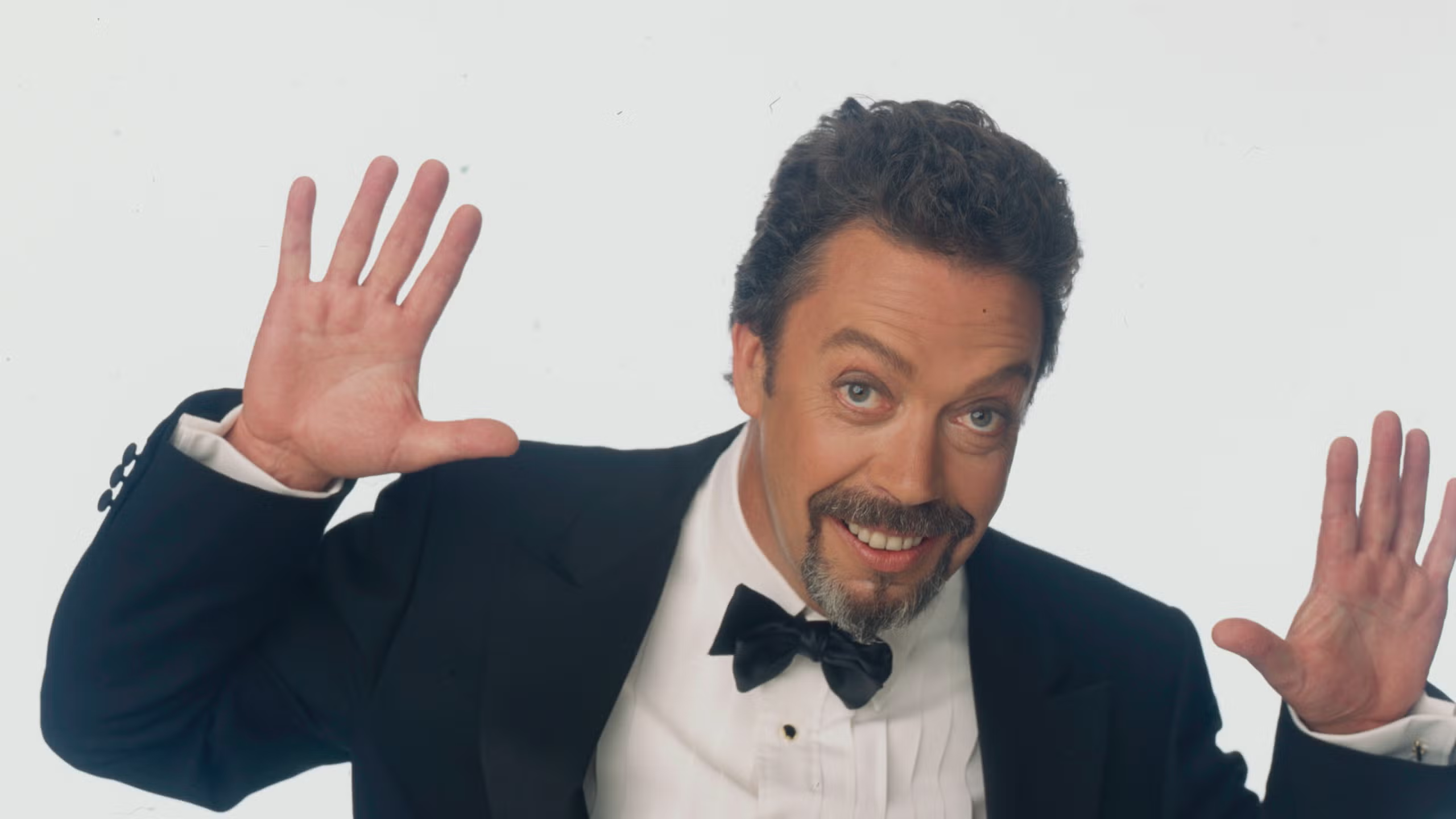
Tim Curry died on Tuesday at his home in Toluca Lake, Los Angeles. He was 80.
His longtime manager and friend Marcia Hurwitz confirmed it. He died peacefully. No cause has been given.
Every obituary today leads with Frank-N-Furter, and that is correct. But Hurwitz's statement ends somewhere unexpected, and the last clause is the one worth stopping on:
"Though he suffered a debilitating stroke in 2012, he continued adding to his achievements as an artist — and, most recently, a writer."
A writer. That is how the person who knew him best chose to finish the sentence.
The thing the stroke did not take
In 2012, at 66, Curry had a major stroke, followed by brain surgery. He used a wheelchair from then on. He kept it quiet for close to a year.
For most actors that is the end of the working life. Curry had fourteen more years, and he spent them using the only instrument he had left — which happened to be the one he had always been best with.
His voice.
It is easy to miss how unusual that voice was, because it is so familiar. It could go from clipped English butler to purring seduction to something genuinely frightening inside a single line, and it always sounded like it was enjoying itself slightly too much. It was the engine of Frank-N-Furter, of Wadsworth, of Pennywise. It was also, after 2012, the entire career: Palpatine and Darth Sidious in Star Wars: The Clone Wars, audiobooks, animation, whatever came.
He was Grammy-nominated in 2006 for reading Lemony Snicket to children. A man who scared a generation as a sewer clown also spent years being the voice that read kids to sleep.
Frank-N-Furter was a stage role, in a room with a hundred seats
The film is the monument. The origin is better.
In 1973, Curry created Dr. Frank-N-Furter in Richard O'Brien's The Rocky Horror Show at the Royal Court's Theatre Upstairs — a tiny room in Sloane Square. He took it to Los Angeles in 1974. Only then came the 1975 film.
And the film flopped. It was pulled from wide release.
What happened next is one of the strangest careers any performance has ever had. Midnight screenings began. Audiences started shouting back at the screen, then dressing as the characters, then arriving with rice and toast and newspapers. The Rocky Horror Picture Show became the longest continuously running theatrical release in the history of cinema — not because it was rediscovered by critics, but because people decided to join in.
Curry did not make a hit film. He made a character so complete that audiences built a fifty-year ritual around it after the movie itself had failed.
The career he actually wanted
Here is the quiet tension in his life, and it deserves saying on the day he dies.
Curry was a stage actor. He was nominated for three Tony Awards — Amadeus, My Favourite Year, Spamalot — and two Oliviers. He won none of them. He played Mozart and Salieri's rival, he played King Arthur, he trained and worked in the theatre for decades.
And he spent his whole life being asked about a corset.
He was, by most accounts, gracious about it. He turned up to the conventions. He understood what the film meant to people who had needed it, and there were a lot of them — Rocky Horror gave a great many teenagers in unfriendly towns somewhere to be on a Saturday at midnight, and Curry was the reason it worked.
But the range is worth listing before it gets flattened. Wadsworth in Clue is a masterclass in farce — the entire final act is one man explaining a plot at a sprint, three times. Darkness in Legend required hours of prosthetics a day and a performance projected through all of it. Pennywise was terrifying in 1990 with almost no effects budget, because the effect was a man's face. Long John Silver opposite Muppets. The concierge in Home Alone 2. Cartoons beyond counting.
He never married
He was asked about it often, and was famously curt about answering. He is not survived by a spouse or children.
What is left
A film that failed and then ran for fifty years. A butler, a clown, a Sith Lord, a pirate, and a scientist in heels. Three Tony nominations and no Tony. Fourteen years of work after a stroke that would have retired almost anyone.
And, at the end, according to the person who knew him: a writer.
No cause of death has been released. Tim Curry died at his home in Los Angeles on August 25, 2026, at the age of 80.