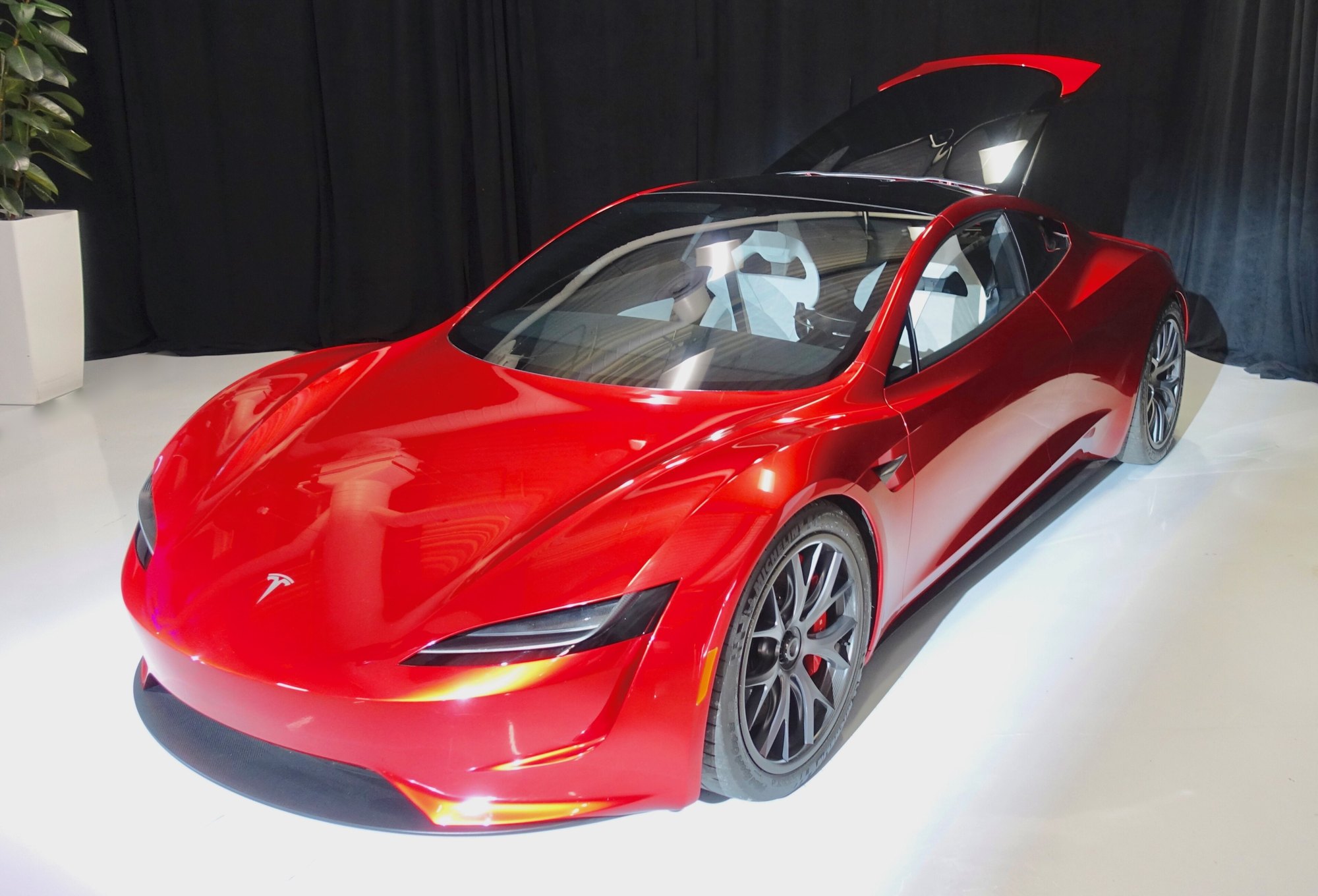
Tesla unveiled the production version of its new Roadster on Thursday, October 15, 2026, at SpaceX's test site near Waco, Texas, nearly nine years after it first showed the car. In livestreamed demonstrations, the car drove upside down on a curved ramp, flipped and landed, and used compressed-air thrusters to hop over a row of parked Teslas. Tesla says production starts in 2028 and hasn't announced final prices.
"Flying cars are real," Elon Musk told the crowd. He also said that "success is not guaranteed."
Quick facts
| Revealed | October 15, 2026, SpaceX facility near Waco, Texas |
| Production | 2028 (Tesla's target) |
| Trims | Performance, Thrust, Rocket |
| Reservations | $50,000 (Performance), $250,000 (Thrust); Rocket invite-only |
| Claimed range | Over 300 miles (480 km), all trims |
| Claimed top speed | Over 230 mph (370 km/h) |
| Claimed 0-60 mph | Under 1.6 s / 0.9 s / 0.59 s depending on trim |
| Final price | Not announced |
Every performance figure above is Tesla's claim. None has been independently tested.
What Tesla actually showed
Two things happened in front of a live audience and cameras, which Musk said was the point, to show it wasn't special effects:
- The ramp. The car drove up a curved ramp until it was upside down, clung to the surface, then launched off the end, rolled 180 degrees in the air and landed on its wheels. Tesla's vice president of vehicle engineering, Lars Moravy, credited a "fan suction system" underneath the car that he said can "pull up to 2 Gs."
- The jump. The car drove at a line of Teslas (a Cybercab, Cybertruck, Semi, Model Y and Model 3) and used thrusters to hop over them.
A screen at the event also showed a 0-60 mph run in under one second.
What Tesla only claimed
Moravy said the top version uses 10 thrusters connected to about 600 liters of compressed air, stored in carbon-fibre overwrapped pressure vessels packed into "every usable void" in the car, and that the tanks can be recharged. It is cold gas, not rocket fuel.
Tesla's website lists three trims:
- Performance ("road ready"): two seats, active aerodynamics, a multi-mode suction system, 0-60 mph in under 1.6 seconds.
- Thrust ("race ready"): two seats, rear cold-gas thrusters, 0-60 mph in under 0.9 seconds.
- Rocket ("air ready"): one seat, thrusters around the car that lift and steer it, 0-60 mph in under 0.59 seconds. Invitation-only.
Musk said the car "will be very different from what was shown previously," and that it is "not necessarily a safety optimised car." TechCrunch reported he said buyers who prioritise safety shouldn't buy it.
How much does it cost?
Tesla hasn't said. Reservation amounts listed on its website, as reported by TechCrunch and Drive Tesla Canada, are US$50,000 for Performance and US$250,000 for Thrust. Rocket is by invitation. CBS News separately reported a $5,000 deposit to reserve the non-flying car, so check Tesla's site for current terms.
For context, the 2017 prototype was promised at $200,000, with a $250,000 Founders Series. Tesla later removed the price from its website.
Is it legal?
Not the flying version, yet. Tesla's own site says the Rocket isn't approved for public roads. The FAA told CBS News the car doesn't meet its definition of an aircraft. A senior Transportation Department official told CBS he was skeptical it could take off and acknowledged there was no clear answer on who would regulate it. NHTSA, which oversees cars but lets automakers self-certify, didn't respond to CBS.
The skeptics
Analyst Dan Ives of Yorkville Ives said the Roadster "will not move the volume or revenue needle," and investors shouldn't treat it as a growth driver. Musk himself called it a halo car that may not move the needle on revenue.
Reviewer Marques Brownlee's reaction on social media: "This is a prank, right?"
Nine years of delays
The Roadster was first shown in November 2017, promised for 2020, with claims of 0-60 mph in 1.9 seconds and 620 miles of range. The date slipped through 2020, 2021, 2023 and 2024, and an October 1, 2026 reveal was pushed back by weather. The production car's claimed range, over 300 miles, is about half the 2017 figure.
For the state of Tesla's core business, see our coverage of Tesla's second-quarter results.
What to watch
Real-world testing. Independent acceleration and range numbers will only come when journalists drive it.
Regulation. Whether NHTSA, the FAA or anyone else takes responsibility for a car that jumps.
2028. Whether production actually starts on time.
Published Sunday, October 18, 2026. Specifications and prices are Tesla's claims as reported by TechCrunch, CBS News, Euronews and Drive Tesla Canada, and have not been independently verified.