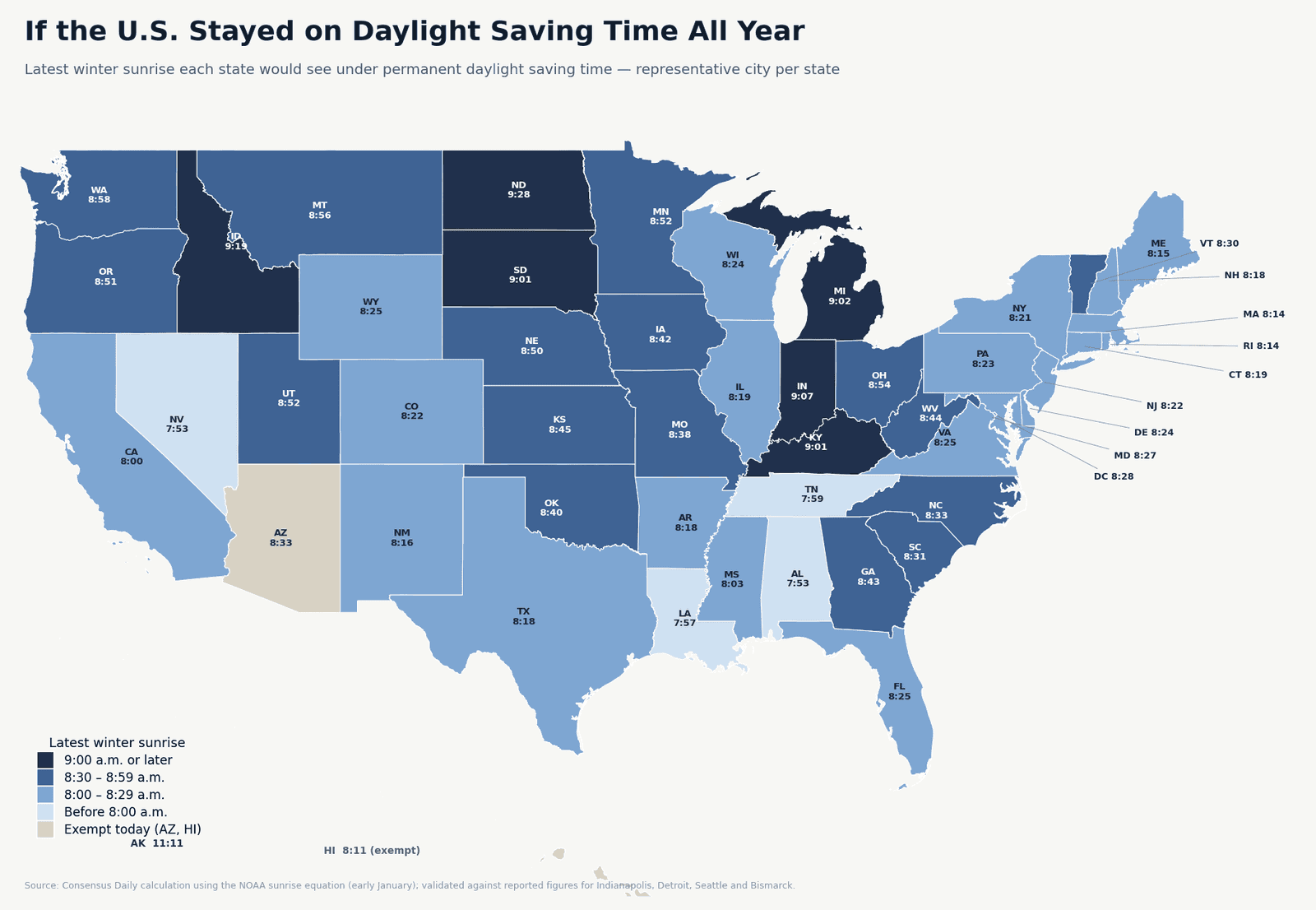
The House has passed the Sunshine Protection Act, a bill to end the twice-a-year clock change by locking the country onto daylight saving time year-round. Backed by President Trump and approved 308–117, it now moves to the Senate. The appeal is intuitive: no more "spring forward," and brighter, later winter evenings. The map above shows the part of the bargain that gets less attention — how dark the winter mornings would become, state by state.
Permanent daylight saving time does not create daylight; it moves it. Keeping clocks an hour ahead all winter pushes both sunset and sunrise later. In the darkest weeks around early January, that means sunsets after 5 p.m. in much of the country — but also sunrises well after 8 a.m., and in a wide band of states, after 9 a.m.
What the map shows
Each state on the map is shaded by its latest winter sunrise under permanent daylight saving time, using a representative city. The pattern is driven by two things: latitude and where a place sits within its time zone. States on the northern tier and the western edge of their time zones fare worst. Under this scenario, Indianapolis would not see sunrise until 9:07 a.m., Detroit until 9:02, and Bismarck, North Dakota, until 9:28 — with parts of North Dakota, Montana and Michigan pushing past 9:30. Even a coastal city like Seattle lands at 8:58.
At the other end, the Deep South and the western edges of the Mountain and Pacific zones are least affected. Places like Birmingham, Nashville and New Orleans stay just under 8 a.m., and much of the interior West sees sunrises earlier still. Nowhere in the lower 48, though, would the sun rise before about 7:50 a.m. at the depth of winter.
The methodology, briefly
The times here are computed with the standard NOAA sunrise formula for early January — near the latest sunrise of the year — for a representative city in each state, then shifted one hour later to reflect permanent daylight time. As a check, the model reproduces the figures news outlets have reported for specific cities: Indianapolis at 9:07, Detroit at 9:02, Seattle at 8:58 and Bismarck at 9:28. Because states span whole regions, the reality varies within each one; a single city can only stand in for the state as a whole.
Two states sit outside the debate entirely. Arizona and Hawaii already opt out of daylight saving and stay on standard time; under the bill they would keep doing what they do now, which is why they are shaded separately.
Why the mornings matter
The late-sunrise problem is exactly what sank permanent daylight saving the last time the country tried it. In the winter of 1974, Americans in cities like Detroit, Minneapolis and Seattle found themselves commuting and sending children to school in the pitch dark around 9 a.m., and public support collapsed within months. Critics today, including Senator Tom Cotton of Arkansas, have raised the same objection — that 9 a.m. sunrises are hard on schoolchildren waiting for buses and on morning commuters.
Supporters counter that later evening light reduces afternoon traffic crashes, boosts retail and recreation, and spares everyone the disruption of changing clocks twice a year. That is the heart of the disagreement: permanent daylight time trades darker mornings for brighter evenings, and permanent standard time — the alternative some lawmakers prefer — would do the reverse.
Where it stands
For now, nothing has changed: the twice-yearly switch is still the law, and the Sunshine Protection Act must clear the Senate and be signed before any of this takes effect. A competing measure, the Sunshine for Our Kids Act, would instead make standard time permanent — keeping the earlier winter sunrises and giving up the later summer-evening light. Nineteen states have already passed laws to move to year-round daylight time the moment Congress allows it. If that day comes, the map above is a preview of the mornings much of the country would wake up to.