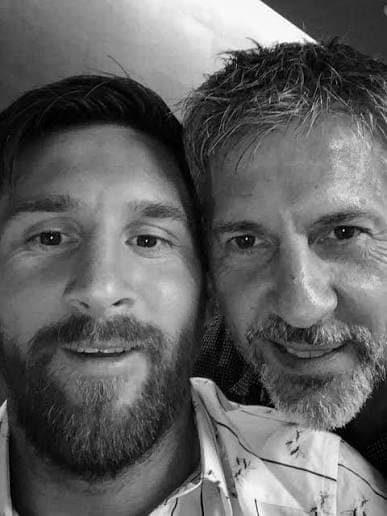
Jorge Messi died on Friday at a medical clinic in Rosario, Argentina, at 68. Reporting indicates he had been receiving treatment for cancer; the family has not confirmed a cause.
The napkin will be in every obituary. It is worth explaining why it exists.
A father looking for medicine
Jorge Messi worked in a steel factory in Rosario. When his third child was 10 years old, the boy was diagnosed with a growth hormone deficiency that required daily injections the family could not afford.
River Plate would not cover the cost.
What followed is usually told as a scouting story — a genius discovered, a club that saw it first. It is more accurately a story about a working man trying to find someone who would pay for his son's medicine, and being willing to trade the boy's football future to get it. The move to Barcelona was not, at the outset, an ambition. It was a solution to a medical bill.
December 14, 2000
Barcelona had seen the boy and wanted him. Barcelona also did what large institutions do, which is take its time.
Jorge Messi told them he was taking his son back to Argentina.
That afternoon, with no contract drawn up and no documents to hand, sporting director Carles Rexach picked up a napkin and wrote:
"In Barcelona, on 14 December 2000 and in the presence of Messrs Minguella and Horacio, Carles Rexach, FC Barcelona's sporting director, hereby agrees, under his responsibility and regardless of any dissenting opinions, to sign the player Lionel Messi, provided that we keep to the amounts agreed upon."
Note the phrase "regardless of any dissenting opinions." A director of the biggest club in the world committing personally, against colleagues who disagreed, on a piece of table linen, because a factory worker from Rosario had run out of patience.
The napkin later sold at auction for about $965,000. The thing it bought was a thirteen-year-old who would win eight Ballons d'Or and a World Cup.
The twenty years after
He became his son's agent and ran his business affairs for more than two decades — through Barcelona, Paris Saint-Germain and Inter Miami. It is an unusual arrangement in modern football, where the family member is normally eased aside by professionals, and it lasted the entire career.
He had four children: Rodrigo, Matías, Lionel and María Sol.
What he actually did
There is a version of this story where a great player was always going to be a great player, and the people around him were incidental — a boy that talented finds his way.
That version is not available here, because the specific obstacle was money for medicine, and the specific solution was a father who moved his family to another continent and refused to leave a negotiation empty-handed.
Whether Lionel Messi becomes Lionel Messi without that fortnight in December 2000 is unknowable. What is knowable is that the treatment was expensive, the family could not pay for it, and one of them made it somebody else's problem.
Tributes have come from across Argentine football, where the Argentine Football Association president described him as the man who believed in his son from the start.