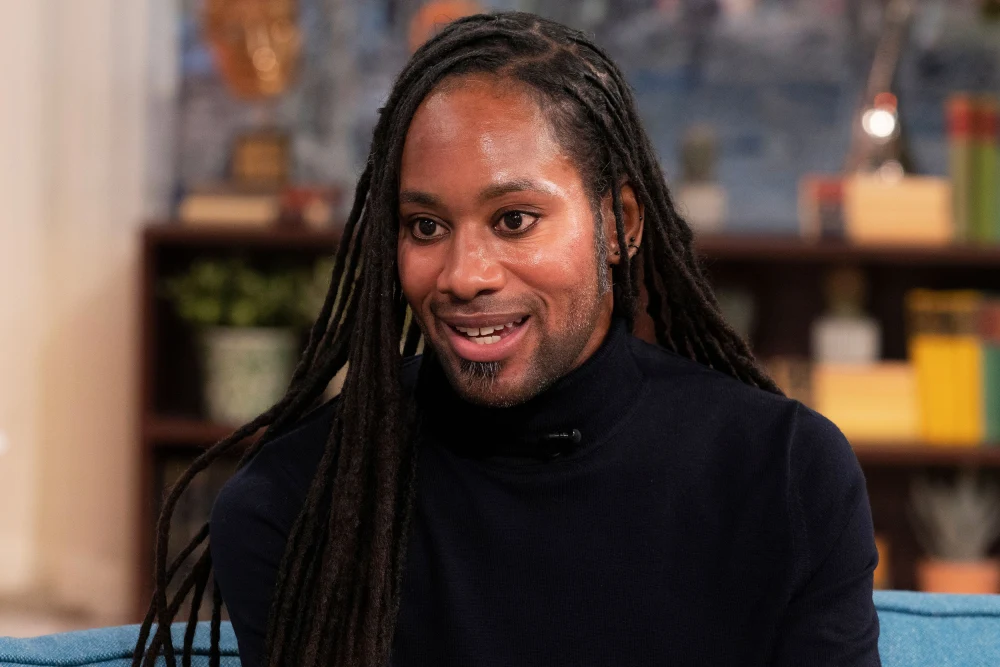
Jason Arday was found unresponsive at a home on Daley Thompson Way in Battersea, south London, shortly after 3pm on Friday. He was pronounced dead at the scene. He was 41.
The Metropolitan Police said the death is being treated as unexpected but is not believed to be suspicious. Nothing further has been established, and nothing further should be assumed.
It was nine days after he resigned from the University of Cambridge.
What his family said
A statement issued through his publisher, Simon & Schuster UK:
"Jason was subjected to a campaign of sustained abuse for the more than three years since he accepted the role of professor at Cambridge University by those who would leave no stone unturned in their quest to undermine him. The campaign of misinformation was too much for Jason, who was a gentle man and who always wanted to see the best in everyone."
"We are in shock to have lost this amazing father, partner, brother, uncle and son. We won't comment further at this point beyond asking the press to leave us alone now, and to stop the campaign of harassment which has been waged against Jason and his family for too long."
Cambridge's Vice-Chancellor, Deborah Prentice, said the university was "desperately saddened to hear this tragic news."
Update, August 16: what has happened since
The Prime Minister has spoken. Andy Burnham, asked about Arday's death on Saturday, urged against "rushing to judgement."
"It's a tragedy on so many levels. It's a moment for reflection… reflecting on how things came to this."
A Cambridge autism expert says he spoke to Arday that morning. Simon Baron-Cohen, director of the university's Autism Research Centre, told BBC radio that he had been in contact with Arday early on Friday. He described what Arday had been subjected to as "relentless scrutiny, including ridicule, discrediting absolutely every detail of his life," and said Arday had not been coping with the loss of his career and reputation.
Baron-Cohen's substantive point is the one worth carrying forward: Arday had been diagnosed in childhood with autism, language delay and learning differences, and Baron-Cohen said he was "vulnerable" and deserved "safeguarding and support."
That is a specific, actionable claim, and it is separable from whether any allegation against him was true. A person can be the subject of a legitimate inquiry and simultaneously be someone an institution had a duty of care toward. Nothing about the first cancels the second.
There will be an inquest. The Metropolitan Police are preparing a file for a coroner, who will formally determine the cause of death. Until then, nothing about how Arday died is established, and this report does not speculate.
In Cambridge and London. Flowers and cards were left on the railings outside Senate House on Saturday. One man who laid flowers told AFP it was "a way for me to apologise to Jason, his family, his friends, for what has been done to him." Vigils were planned in London for Sunday and Monday evenings, and a crowdfunder started by the racial equality campaigner Patrick Vernon had passed £11,000 for Arday's family by late Saturday.
The publisher. Simon & Schuster, which released Great and Unfortunate Things in the United States days before his death, said it was "deeply saddened by the news of Jason Arday's tragic death."
The argument has split into two, and both sides are now organised
Weyman Bennett, co-convenor of Stand Up to Racism, said the death "was the result of a racist witch hunt" by right-wing media, politicians and the far right. More than two dozen academics and politicians had already characterised the allegations as a smear campaign aimed at undermining Arday and other Black people in positions of influence.
Against that: the underlying questions were raised by named journalists at three national newspapers, and one of them — the plagiarism analysis — is a document comparison that either holds up or does not. The Times published its analysis of Arday's 2015 thesis on July 24, identifying passages it said were "identical or near-identical" to an earlier paper by another researcher. The Guardian and the Telegraph ran separate investigations.
Arday's own answer, given to the Times before his death, was that he had made "mistakes" but was being wrongly portrayed as a liar and a fantasist — and that some errors in his early academic work stemmed from his autism, because he relied on mimicry to process information.
That explanation deserves to be recorded rather than dismissed, and it also has not been tested by anyone. It cannot be now.
A correction to our earlier framing
Our first report leaned on the fact that Dave Harris says he alerted Cambridge and Liverpool John Moores to plagiarism concerns in 2023, and treated the subsequent silence as institutional failure.
That still matters, but the picture is more complicated than we presented it. Cambridge's initial position was that the plagiarism allegations had already been investigated by Liverpool John Moores University — the institution that awarded Arday's doctorate and the body with the standing to assess it. On that account, Cambridge was not ignoring a warning; it was deferring to the university that had examined it.
Whether that deference was reasonable is exactly what the inquiries now have to answer. But "Cambridge was told and did nothing" is too simple, and we should have had that qualification in the original piece.
What Cambridge has now committed to
Vice-Chancellor Deborah Prentice said this week that the university will run a review of its hiring processes for senior academic roles, alongside the investigation into Arday's appointment and tenure. Dozens of Cambridge academics had signed a letter demanding an independent inquiry into how he was appointed.
Prentice also addressed the thing this case has been used for:
"Our staff of colour are highly valued, for their scholarship, their achievements and the contributions they make to the institution and the wider academic community. This particular case is an aberration and should not be used to cast aspersions on their work or the legitimacy of their roles at Cambridge."
Glasgow University, where Arday previously worked, has also announced a review of his earlier academic work.
The detail almost nobody is leading with
Dave Harris, an emeritus professor at Plymouth Marjon University, says he alerted Cambridge and Liverpool John Moores University to his concerns about plagiarism in Arday's work in 2023.
That is roughly three years before any of this became a public story.
If that account is accurate — and Harris has put his name to it in the Telegraph — then everything that followed happened downstream of institutions that had been told. The appointment continued. The honours accumulated. The television bookings, the honorary doctorates, the memoir deal.
And then in 2026 the matter surfaced not through an academic process but through a Substack post, a newspaper investigation and a culture-war news cycle, which is the least controlled and least fair mechanism available for resolving a question about a doctoral thesis.
There is a version of this story where the allegations are examined quietly in 2023 by the two universities that granted and employed the credential, a finding is reached, and it is either dismissed or acted on. Nobody's life is conducted in public. That version was available and it did not happen.
What was actually alleged, and what was established
This needs separating, because the coverage has run it together.
Alleged, unresolved: That passages of Arday's doctoral thesis were plagiarised. The Telegraph reported on July 24 that analysis found more than 100 passages resembling an earlier thesis by another researcher. Harris said in the same reporting that important sections of "both his PhD thesis and some subsequent published articles" appeared to him to show "indications of serious plagiarism." Cambridge opened investigations into his academic qualifications and honorary appointments, and separately handled misconduct complaints. It has published no findings. No adjudication of the plagiarism question exists.
Alleged, disputed: That claims about his athletic achievements — including running 600 miles in six days, and 30 marathons in 35 days — and about raising more than £5 million for charity were inflated. Asked about the fundraising figure, Arday said the money was raised with the help of "many fundraising collectives over a two-decade period."
Reported as findings: The Guardian's Lanre Bakare investigated two incidents Arday had described publicly — a masked intruder at his workplace, and a pig's head sent to his parents' home. The Guardian reported finding no CCTV evidence and no corroborating staff account for the first, no supporting evidence for the second, and that the Met denied an inquiry had taken place. Those are findings, not allegations, and they are the most serious element of the case against him.
Arday's position throughout was that he had made mistakes but was being mischaracterised. To the Times: "We're talking about academia here. I didn't murder somebody. I think the cruelty that I've experienced and the positioning of me as this kind of liar and fantasist is totally unacceptable."
The part that cuts the other way
Fairness requires this to be in the same piece.
In September 2025, Jack Grove of Times Higher Education assembled a report on the plagiarism allegations and approached Arday for comment. Arday responded with a legal letter from Carter-Ruck. The story was not published.
Arday also complained to the Metropolitan Police about Grove, which opened a four-month investigation into a journalist. Commissioner Mark Rowley later acknowledged the force had "dropped the ball," and that the complaint should have been "screened out earlier on as not requiring investigation."
A reporter spent four months under police investigation for asking questions about a thesis. Whatever else is true, that happened, and it is not a small thing. It is also part of why the story eventually broke the way it did — through a Substack post rather than a journal of record.
On who made the allegations
The initial public allegations came from Nathan Cofnas, a philosopher who describes himself as a "race realist" and who was fired by Cambridge's Emmanuel College in 2024.
That context belongs in the story, and so does the following: a critic's motives do not establish whether the claim is true. Plagiarism is a question about two documents. It is answerable by comparing them, and it is answerable regardless of who asks. The Telegraph's analysis, and Harris's 2023 complaint, exist independently of Cofnas.
The reverse also holds. That an allegation originates with someone whose views many find repugnant does not make it false — and treating it as automatically false is precisely the failure mode that lets a complaint sit for three years.
Cambridge initially took the first position. The university said Arday had been the victim of a "vile campaign to undermine his credibility" and suggested those raising concerns were motivated by racism. It then opened an investigation into its own appointment.
Both of those cannot have been the right response, and the university has not explained the change.
The question that outlives him
A group of senior academics led by Cambridge professor Priyamvada Gopal had already written jointly to demand an independent investigation into how Arday was appointed in the first place — arguing he may have been a "quick fix" for an institution with a diversity problem it wanted solved quickly, and warning that the affair would set back the modest progress Cambridge has made on historical underrepresentation.
That is the strongest formulation of the institutional question, and it comes from people with every reason to want the appointment to have been sound.
Because the appointment was Cambridge's. The vetting was Cambridge's. The celebratory press release in 2023 was Cambridge's. The decision to call the critics racist was Cambridge's. And the review of how senior appointments are made — now under way — is an admission that the process that produced this needed reviewing.
A man is dead, and the plagiarism question is now unanswerable in any way that matters to him. The institutional question is not. It is entirely answerable, it is the university's to answer, and it will be the easiest thing in the world to let quietly lapse.
The cause of Jason Arday's death has not been established and this report does not speculate on it. His family has asked for privacy.
This is a sensitive subject. If you are struggling, support is available. In the UK, Samaritans can be reached free on 116 123, at any hour. In the US, the 988 Suicide & Crisis Lifeline can be reached by calling or texting 988.