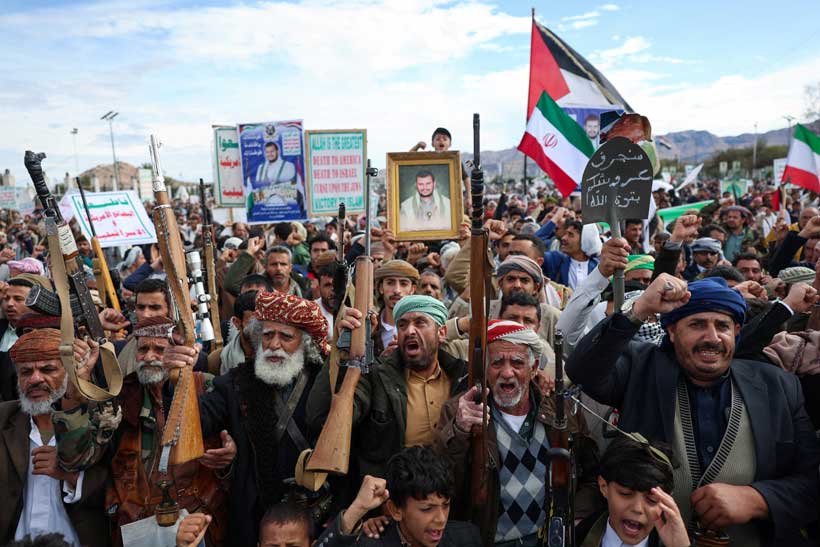
Yemen's Iran-aligned Houthi movement said it attacked two Saudi oil tankers transiting the Red Sea, an escalation that threatens to open a new front in the widening conflict between the United States, Israel and Iran. The group's military spokesperson, Yahya Saree, said fighters had targeted the tankers Encelia and Layla for violating a naval blockade the Houthis declared against Saudi Arabia days earlier.
Saudi Arabia confirmed that at least one of the ships was struck. The Saudi Press Agency, citing an official at the kingdom's Transport General Authority, said the Encelia had been hit and that all of its crew members were safe. The agency did not address the claimed strike on the Layla. A neutral monitor, the UK Maritime Trade Operations center, said it had received reports that a tanker's master reported being hit by an unknown projectile, sparking a fire that the crew were still fighting.
How the attack unfolded
According to the Houthis, the tankers were struck with a combination of ballistic and cruise missiles and drones, setting fires aboard both vessels. Saree said the group had also forced nearly ten other ships to abandon their routes and turn back, part of an effort to make the blockade felt across Saudi-linked shipping. Beyond Saudi Arabia's own confirmation of the Encelia, independent verification of the full scope of the claims was not immediately available — a common feature of fast-moving maritime incidents in the region.
The strikes mark a sharp turn from words to action. The Houthis, formally known as Ansar Allah, imposed the maritime blockade on Saudi Arabia on July 20, framing it as an "eye for an eye" response to what they describe as years of Saudi-led siege on the ports and airports they control. The declaration followed some of the worst violence Yemen has seen in four years, after the internationally recognized Yemeni government bombed the Houthi-held Sanaa airport to stop an Iranian plane from landing.
Two competing narratives
The confrontation is being told in two very different ways. The Houthis cast their blockade as legitimate retaliation, accusing Saudi leaders of imposing "an unjust and oppressive siege" for nearly 12 years and of "plundering" Yemeni resources. One Sanaa-based analyst argued the group's ultimate aim is to pressure Riyadh into lifting restrictions on Houthi-controlled ports and airports.
Saudi Arabia rejects that framing. Riyadh denies running a siege against the Yemeni people, and critics of the Houthis note that the group recently turned down a Jordanian proposal to resume flights between Amman and Sanaa — undercutting, in their view, the claim that Saudi Arabia alone is responsible for Yemen's isolation. Riyadh also condemned the tanker attacks as a violation of international laws meant to protect commercial vessels and their crews.
Why the Red Sea is the real prize
The strategic weight of the attack lies less in two tankers than in the waterway itself. With the Strait of Hormuz effectively closed since the outbreak of the wider war, Saudi Arabia has been leaning on alternative routes through the Red Sea and the Bab al-Mandeb Strait to keep its oil moving. Those routes are now precisely what the Houthis are targeting.
Bab al-Mandeb, the chokepoint linking the Red Sea to the Gulf of Aden, is one of the most important shipping arteries on earth. At its narrowest it is just 29 kilometers — about 18 miles — wide, and in 2024 roughly 4.1 billion barrels of crude and refined products passed through it, close to 5 percent of global supply. The Houthis have shown before that they can disrupt it: their campaign against shipping after the start of the Gaza war rerouted global commerce for months. Analysts warn that if Bab al-Mandeb were shut alongside an already-closed Strait of Hormuz, as much as a quarter of the world's oil and gas supply could be blocked.
That is the scenario now hanging over the region. A pair of tanker strikes may look like a contained incident, but they land at the intersection of a Yemeni war, a Saudi rivalry with the Houthis, and a broader confrontation with Iran — and on a stretch of water the global economy cannot easily do without. Whether this remains a warning shot or becomes the start of a sustained campaign is the question that will shape the days ahead.