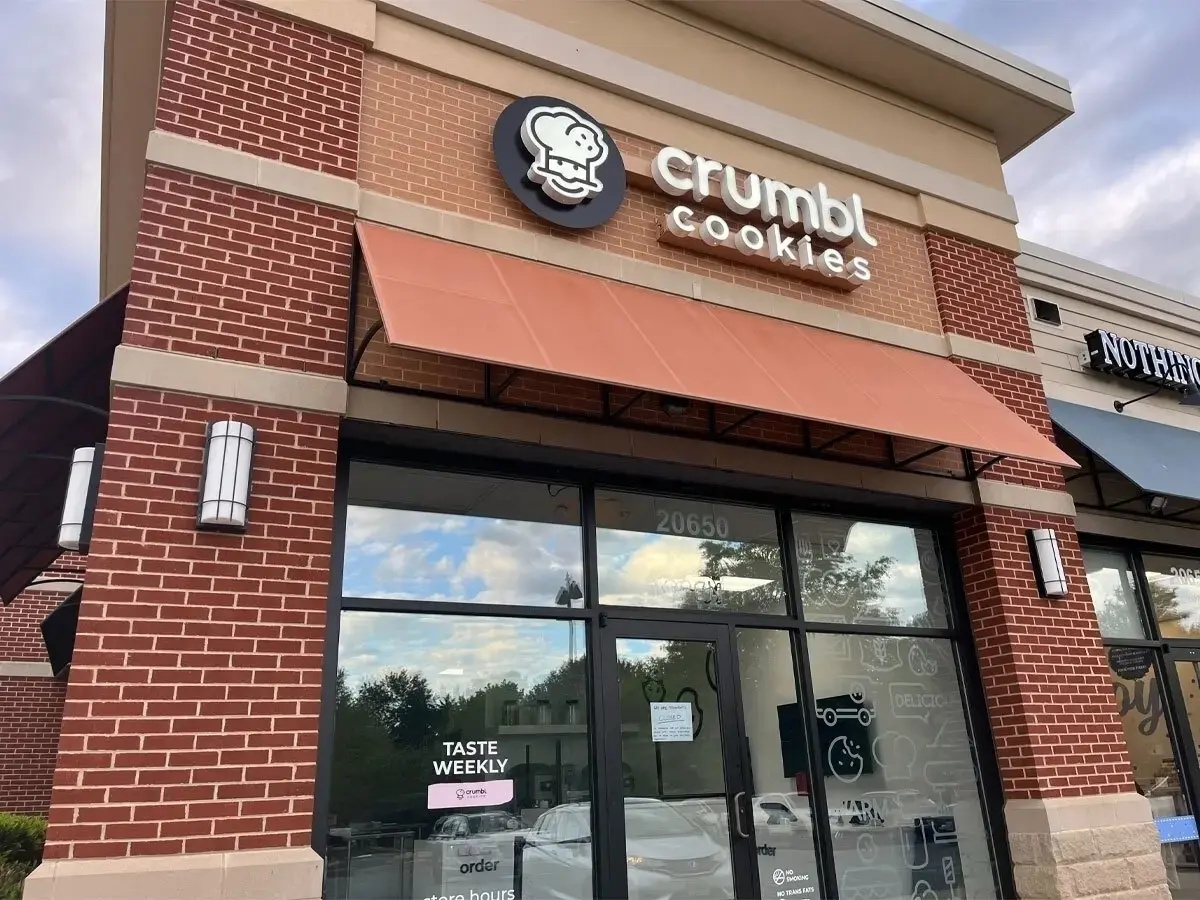
Crumbl Cookies has closed at least 57 stores this year, Restaurant Business reports. At least 55 more franchises are listed for sale on broker websites.
The chain's CEO, Jason McGowan, reportedly told franchisees in September that the losses were "painful." Then he said: "It's my fault where we are today."
Fifty-seven stores out of more than 1,000 is about 5%. On its own, that is a correction, not a collapse. The more important numbers are the ones a franchisee sees.
The two numbers that matter
What it costs to open one. In 2019, Crumbl's franchise disclosure listed a total investment of $129,000 to $252,000. The 2026 disclosure lists $848,566 to $1.47 million. At the top end, that is nearly six times as much.
What one earns. Average annual sales per store peaked at $1.84 million in 2022, according to figures published by Restaurant Business. In 2025 the average was $1.14 million. That is lower than in 2020, when the chain was a fraction of its current size.
| Year | Average sales per store |
|---|---|
| 2020 | $1.27 million |
| 2021 | $1.69 million |
| 2022 | $1.84 million |
| 2023 | $1.16 million |
| 2024 | $1.36 million |
| 2025 | $1.14 million |
Put those together. A franchisee opening today pays far more for a store that, on average, brings in about 38% less than one did at the peak. That gap is where the closures come from.
What went wrong
It grew faster than demand. Crumbl added a net 281 stores in 2023 alone. Franchised units went from 690 at the start of 2023 to 1,101 at the end of 2025. More stores split the same customers. Average sales fell 37% in 2023, the year of the biggest expansion.
The novelty wore off. Crumbl's model is a weekly rotating menu built for social media. That works while the pink box is new. "Sweet treats are not something people tend to have all the time," Maeve Webster of the consultancy Menu Matters told Franchise Times.
Traffic is falling. Placer.ai data cited by Restaurant Business shows visits down 32% year over year. Documents provided to the publication show August sales 70% lower than two years earlier. Several franchisees called it the worst month in company history.
The fixes have not landed. A push into "dirty sodas," meant to lift 2025 sales, drew criticism online over their sugar content. Crumbl has also laid off much of its franchise support staff, according to Franchise Times, just as franchisees most need help.
What one failing store looks like
On October 1, a company called Red Sheep St. Matthews filed for Chapter 7 bankruptcy in Kentucky. It ran one Crumbl, opened in February 2024 in St. Matthews, outside Louisville.
According to the filing, the store took in $128,143 in 2024 and $84,313 in 2025. The chain average was more than $1 million. It listed $352,780 in liabilities against $10,000 in assets. The largest creditor was a bank owed $269,108 for cooking equipment.
The owners still run two other Louisville-area Crumbls. One bad store does not define a chain. But it shows what an owner is left holding when a location does not work: the loan for the ovens.
It is not just Crumbl
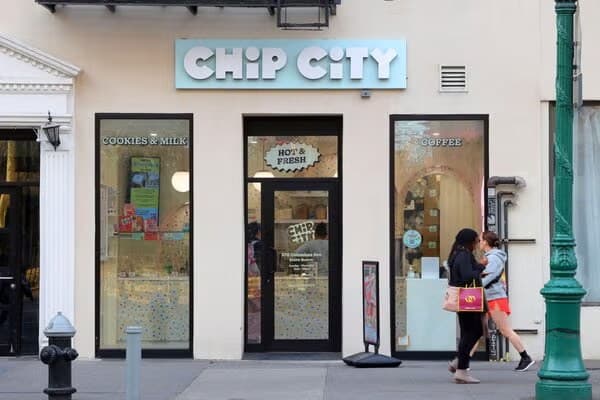
Chip City, the New York chain backed by Danny Meyer's investment fund, closed its remaining stores, about two dozen, on October 1. It told staff "we no longer have the funding required to operate this business."
Dirty Dough has fallen from 58 stores to fewer than 40 and stopped selling new franchises. Cookie Plug's website lists 13 locations, down from 34 in early 2025.
One cookie brand is still growing: Insomnia Cookies, now past 360 stores. It owns its stores instead of franchising them. That does not prove company-owned is better, but it is the one big chain in the category not shrinking.
Restaurant Business put it plainly in a headline: the cookie boom, "like others before it," is proving temporary.
What to watch
The for-sale listings. Fifty-five franchises on the market is the best early signal of the next round of closures.
Crumbl's next disclosure document, which will show 2026 sales per store and how many units closed or changed hands.
Whether it slows openings or cuts the cost of entry. Raising the price of a franchise while sales per store fall is hard to sustain.
Whether Crumbl talks. It has not responded to requests for comment.
Published Saturday, October 17, 2026. Closure counts, sales figures and the August data come from Restaurant Business and Franchise Times; franchise costs and average unit volumes come from Crumbl's franchise disclosure documents as reported by those outlets. Crumbl did not respond to requests for comment.