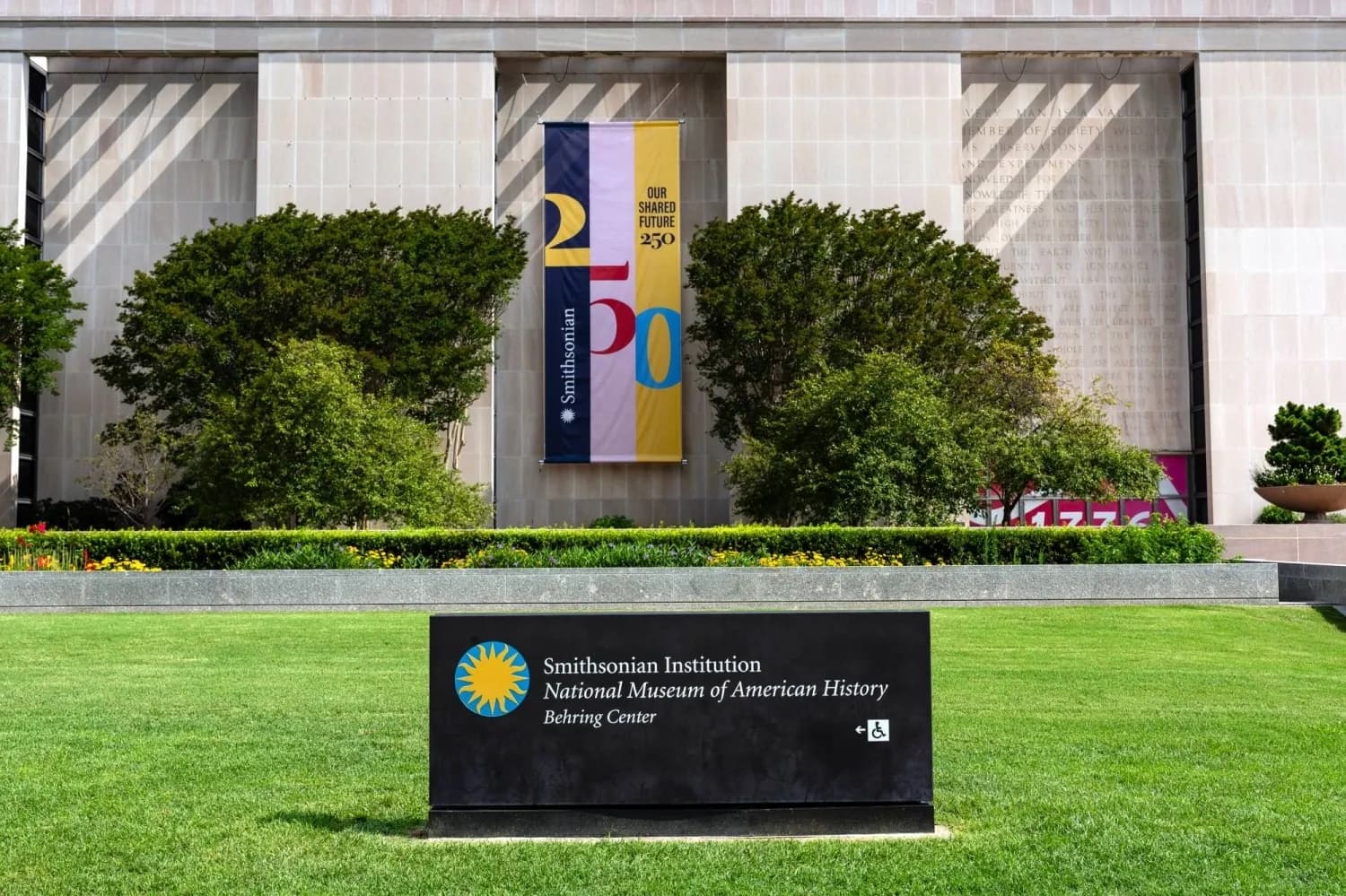
President Trump signed an executive order on Friday directing the National Park Service to install temporary signs near the Smithsonian's National Museum of American History, warning visitors that its exhibits contain inaccurate information.
The signs are to tell visitors that the museum's exhibits should be renovated in line with the findings of a White House report, and to point them toward other sources for what the order describes as accurate information about American history.
Why the sidewalk
The most revealing detail is where the signs are going.
The president has no authority to fire the Smithsonian's leadership or to order changes to its exhibits. The Smithsonian is not an executive branch agency — it is a trust instrumentality governed by a Board of Regents, a structure that has insulated it from direct presidential control since 1846.
What the administration does control is the National Park Service, which maintains the land outside. So the order regulates the pavement.
That is not a rhetorical characterization; it is the operative mechanism of the order, and it explains both the unusual form the action took and why the administration chose signage rather than a directive to the institution.
The report behind it
The signage refers to "Saving America's Story," a 162-page report published July 4 by the White House Domestic Policy Council, which accuses the Smithsonian of advancing radical left-wing ideology in its presentation of American history.
It follows a March 2025 executive order, "Restoring Truth and Sanity to American History," which directed Vice President JD Vance to block spending on exhibits the administration considered inconsistent with its view of the national story and to seek the appointment of citizen regents aligned with its priorities.
The museum's director was questioned about the report at a congressional hearing on July 21.
The Smithsonian's answer
The institution has not accepted the report's characterization. "While there will always be room for improvement," it said, "this report is not a fair characterization of the work and totality of the National Museum of American History." It has previously described itself as committed to "continuous and rigorous scholarship and research and unbiased presentation of facts and history."
The American Historical Association has publicly defended the museum.
Two arguments, stated plainly
The administration's case: the Smithsonian is federally funded and presents an account of American history to millions of visitors, including schoolchildren. If an elected administration believes that account is ideologically slanted, it argues, it is entitled to say so publicly and to direct visitors to alternative sources. Nothing in the order removes an exhibit or compels the museum to change anything.
The critics' case: the federal government posting signs declaring a museum's scholarship inaccurate is a form of official pressure on independent historical work, and doing it on the sidewalk because the front door is closed makes the intent clearer rather than softer. Historians' organizations argue that the objections are to interpretation rather than to factual error.
An unusual constitutional wrinkle
Because the Chief Justice of the United States serves as the Smithsonian's chancellor, House Minority Leader Hakeem Jeffries directed his objection to the order at John Roberts, calling it "cowardly and unpatriotic" and asking him to reject it.
That puts the sitting Chief Justice in the position of being asked to referee a dispute between the president and an institution he formally helps govern — while the Vice President also sits on the same board. It is the kind of overlap that rarely matters until it does.
What happens next
The signs are described as temporary, and the order does not specify how long they remain or what would satisfy the administration enough to remove them. The Smithsonian has not said whether it will contest the installation.