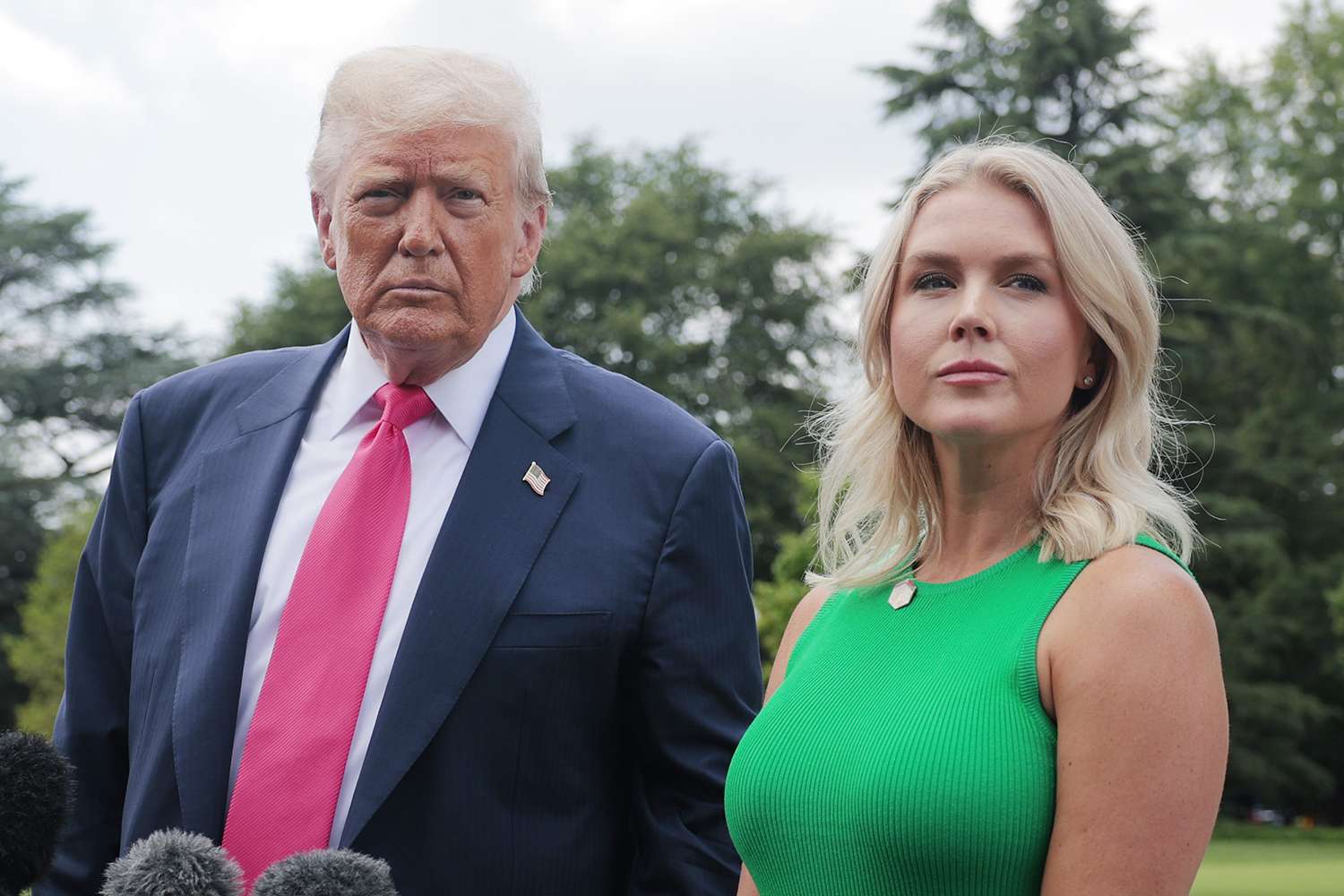
President Trump announced on Truth Social on Wednesday that Karoline Leavitt will step down as White House press secretary at the end of August, so she can spend more time with her beautiful young children and family, a decision I totally understand and respect!
The same post said she will become "one of my top outside advisors" and "an influential voice within the Republican Party" heading into the November midterm elections.
Both sentences are in the announcement. Almost every account of this story leads with the first one.
What actually changed
Leavitt is not leaving the work. She is leaving the podium.
The distinction matters because those are different jobs with different demands. The press secretary briefs on the record, on camera, on someone else's schedule, and answers for every decision the administration makes that week. A senior outside adviser working the midterms sets their own calendar, travels when they choose, and is accountable to nobody with a microphone.
For a person with a three-month-old and a toddler, that is a meaningful improvement in daily life — which is exactly why the family explanation and the midterm assignment are not in conflict. They fit together. She is trading a job that cannot be done part-time for one that can.
What she is not doing is stepping back from politics three months before a national election.
The case that the family reason is sincere
It would be easy, and lazy, to treat "more time with family" as a euphemism. Here is the case against that reading, which deserves to be stated properly.
Leavitt is 28. She took the job at 27, the youngest press secretary in American history. She went on maternity leave in late April and gave birth to her daughter Viviana on May 1 — her second child with her husband, real estate developer Nicholas Riccio. She was back at work quickly.
Her own statement is specific in a way that boilerplate usually is not:
"Since returning to the White House after the birth of my daughter, I have felt in my heart that I cannot be the best mom my two young children deserve while devoting the constant time, energy, and attention required of the White House Press Secretary."
She also called it "the most rewarding yet challenging season of my life, to say the least."
Anyone who has returned from parental leave to a job with no natural stopping point will recognise that. The press secretary's role has no version where you leave at five. The most probable reading is that both things are true at once: the family reason is real, and the midterm role is the arrangement that makes leaving possible without leaving.
Her statement also included a parting attack on Democrats who she said "seek to destroy everything great about America" — which is its own answer to whether she is stepping back from the fight.
The record, and the argument about it
Leavitt was the administration's most visible defender through Signalgate, the release of the Epstein files, and the Iran war. Her tenure is genuinely contested, and both cases are worth putting down plainly.
The critique, made most prominently by her predecessor-once-removed Jen Psaki on MS NOW on Thursday, is about the room itself. Psaki said the press-White House relationship is "supposed to be adversarial by design," and that Leavitt "didn't want to engage in good faith with those reporters and their tough questions."
"She did everything she could to reshape that briefing room into her own personal safe space where she rarely had to answer a tough question, hardly ever. I mean, she only briefed once or twice a week, max."
Psaki's substantive charge is not about tone but about who the job serves: "That room is supposed to be where the American people get answers about what their government is doing."
The defence is that Leavitt was effective at the job as it actually exists. A veteran White House reporter told Fox News Digital she was "the best press secretary I've ever worked with, and there have been many," attributing it to the fact that "she spent real time with Trump, as well as time understanding his policies and reasoning behind them" — the argument being that a press secretary who genuinely speaks for the president is more useful to reporters than one who does not, regardless of what they think of the president.
The White House response to Psaki, from spokesman Davis Ingle, was one line: "Jen 'Circle Back' Psaki couldn't hold a candle to Karoline Leavitt."
The disagreement is real and it is not resolvable by fact-check, because the two sides are measuring different things. Psaki is measuring the briefing room as a public accountability mechanism. Her defenders are measuring it as a communications channel. Leavitt's own defining change — opening the press corps to influencers and MAGA-friendly outlets, which she told Axios in April 2025 was an expansion of access rather than a restriction of it — makes sense under the second definition and looks like the problem under the first.
The replacement race is being priced on a betting market
No successor has been named. The most revealing thing about the search is where it is being handicapped.
On the prediction market Kalshi, the frontrunner is Scott Jennings — a CNN commentator, at roughly 29 percent, up about 24 points in 24 hours. Behind him: Anna Kelly, the principal deputy press secretary who already does the job's daily mechanics, at about 17 percent, and attorney Alina Habba at about 16 percent. Also circulating: Katie Miller, communications director Steven Cheung, Roma Daravi, Kari Lake, and Breitbart's Matthew Boyle.
Prediction-market odds are not reporting. They price what a small number of traders think, they move on rumour, and a 24-point swing in a day is a sign of thin volume rather than new information.
But the shape of that list is a fact about the job. The internal candidate with the operational experience is running third. The leaders are people known for televised argument — a cable panelist and a litigator who became familiar defending Trump on camera. Whatever the White House chooses, the market's read is that the qualification is combat, not press operations.
That is a change from what the position used to be, and it did not start with Leavitt. It is the direction the job has been travelling for a decade under both parties, and she was very good at the version of it she inherited.
What to watch
Whether the successor comes from inside the press shop or off television — the single clearest signal of what the administration thinks the job is for. Whether briefing frequency changes, which is the one measurable part of Psaki's critique. And what "top outside adviser" turns out to mean in practice between now and November, because that is the role Leavitt is actually taking.
This story will be updated when a successor is named.