Update, August 16: the FX5 has not shipped. It was due around August 18. B&H now says "September," Adorama says September 15, and North American dealers told PetaPixel they have received no units at all. Sony has offered no public explanation. The full picture is below; the original specification breakdown follows it.
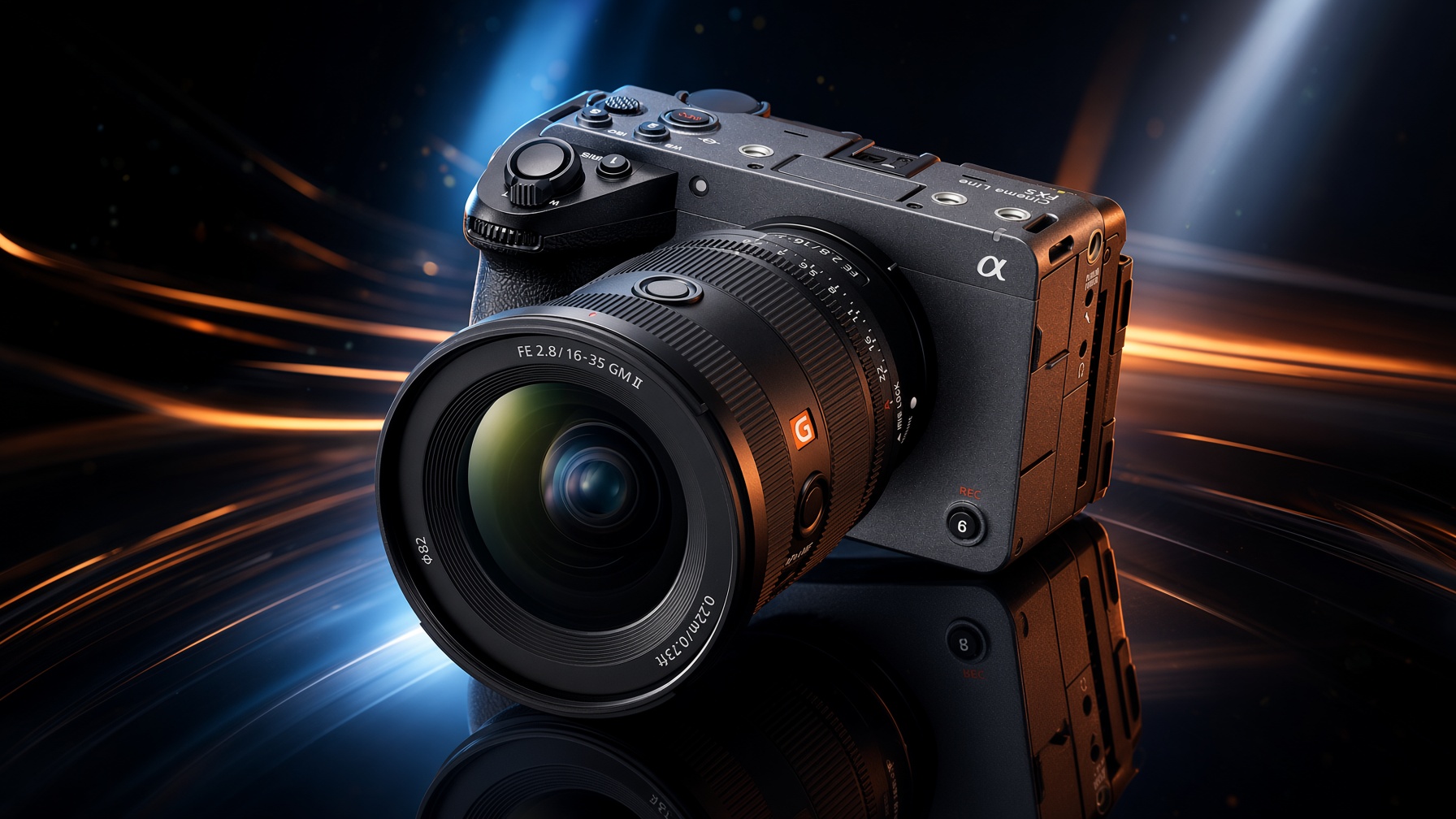
Sony's FX5, announced July 22, is the first camera in the company's FX line to offer full-frame open gate recording and internal 16-bit X-OCN RAW — two things filmmakers have been asking Sony for since the FX3 arrived. It sits between the FX3 and the FX6 at $4,899.99 body-only, and it is not a warmed-over FX3.
It is also a camera with more asterisks than the launch coverage suggests. Here is what is actually in the box, what is not arriving until 2027 — and why none of it is in anyone's hands yet.
The delay: three explanations, one of them documented
1. "Orders exceeded expectations" — Sony's own account, and it does not fit
When Japanese pre-orders opened on July 28, Sony posted a notice on its website:
"The professional camcorder 'FX5' has received orders that greatly exceeds our expectations, and it may take time to deliver the product. We are currently working hard to meet the needs of our customers as much as possible, so please wait for a while."
Strong demand explains a backlog. It does not explain zero. If the constraint were simply that Sony under-forecast, the earliest pre-orders would have been filled first and later ones pushed back. Instead, dealers say nothing has arrived at all — which is a supply or hold problem, not a queue problem.
2. A quality-control issue — widely reported, entirely unconfirmed
Over the weekend of August 8–9, rumours started coming out of Japan. Canon Rumors said two sources described an unspecified QC issue that needed resolving before units left dealer stock rooms. SonyAlphaRumors subsequently published emails from German retailers telling customers that "a final quality adjustment is being made prior to the shipment" with availability "expected in early September."
That retailer language is the closest thing to a corroborating document, and it is still a retailer paraphrasing Sony rather than Sony speaking. PetaPixel described the QC theory as "purely speculation." Nobody has said what the defect is.
The distinction that matters to anyone holding a pre-order: a firmware fix means a short delay. A hardware fix could mean recalling and swapping inventory already in the channel — a much longer wait, and a much worse look. Sony has not said which it is, and no recall exists.
3. The earthquake — the only part of this that is on the record
On July 28, the same day Sony posted its "orders exceed expectations" notice, a major earthquake struck Kumamoto Prefecture.
Kumamoto is where Sony Semiconductor's Kumamoto Technology Center sits, in Kikuyo-machi. It is Sony's largest image sensor plant. Sony confirmed that operations were halted, that safety inspections and recovery work followed, and that the site would resume in stages from August 4, expecting to reach pre-earthquake output by mid-August.
Now hold that against what the FX5 actually is. Its headline component is a newly developed 16.6-megapixel stacked Exmor RS sensor — a part with no existing inventory, ramping for the first time, in the weeks a sensor fab went offline.
No outlet has confirmed the FX5's sensor is made at Kumamoto, and neither can we. Sony has not linked the two. But of the three explanations in circulation, this is the only one supported by a documented event with a documented timeline, and it is the one getting the least attention because "quality control issue" is a more interesting headline than "supply chain."
(One correction worth carrying: both PetaPixel and RedShark describe the quake as magnitude 7.1. That was the Japan Meteorological Agency's preliminary figure; the USGS later revised it to 6.8. We covered the Kumamoto earthquake and its aftermath at the time.)
What a buyer should actually do
Nothing has changed about the camera. What has changed is the date, and the confidence you can place in it.
- B&H: "September," no day given
- Adorama: September 15, 2026
- German retail: "early September"
- PetaPixel's read: mid-September, and not every retailer has been given a new ETA
Treat all of those as estimates. The honest position is that Sony has not publicly acknowledged the delay at all, which means no date currently comes from the company. If you are scheduling a shoot around this camera, do not.
What follows is our original July 24 breakdown of the FX5's specifications, which is unchanged.
The new sensor
At the core is a newly developed 16.6-megapixel full-frame stacked Exmor RS CMOS sensor, paired with the BIONZ XR2 processor and a dedicated AI unit. For comparison, the FX3, FX3A and FX6 all run a 12.1MP Exmor R BSI sensor and the older BIONZ XR. This is a generational jump, not a tweak.
Sony rates native dynamic range at 15+ stops. A Dual Gain readout mode pushes the claim past 16 stops. Worth being precise: this is a dual gain readout, not a dual gain sensor, which is a different piece of engineering than the shorthand implies.
Three base ISOs — 800, 4000 and 12800 — follow the approach Canon took with the C80.
Recording formats, and one spec worth checking
The sensor supports 5K 60p, 4K 120p and Full HD 240p.
Some coverage has listed 5K120 in 16:9. Sony's own format breakdown says full-frame 16:9 (4992 × 2808) tops out at 5K 60p, and the sensor specification says the same. Until Sony publishes a complete frame-rate matrix, treat 5K120 as unconfirmed.
The recording areas:
- Open gate — 3:2, 4992 × 3328, full sensor height, up to 60p
- Full-frame 17:9 — 4992 × 2632
- Full-frame 16:9 — 4992 × 2808, up to 5K 60p
- Full-frame crop — 4.5K 17:9, 4.5K 16:9, 3.8K 16:9
- Super 35 — 3264 × 1836
In the 17:9 and 16:9 full-frame modes, XAVC is capped at 4K; the higher resolutions require X-OCN.
The open gate catch
This is the part that matters, and the part most write-ups skip.
Open gate at launch is X-OCN only. You cannot record open gate in XAVC. That capability is on the firmware roadmap for 2027. If your workflow is XAVC-based and open gate is your reason for buying, you are waiting a year — and paying for VPG400 cards in the meantime.
Sony's Version 2.0 firmware, scheduled for August 2027 or later, is slated to add:
- 4K 240p X-OCN recording
- Open gate 3:2 in XAVC-I
- An optimized interface for vertical shooting
- Frame Grab for still-image extraction
X-OCN, and what it costs you in media
The FX5 is the first camera below the BURANO to record X-OCN internally, with no external recorder required — unlike the VENICE 2 and its AXS-R7. Three variants are available:
| Variant | Positioning | 5K24 open gate |
|---|---|---|
| X-OCN LT | Indie features, TV, commercials, docs | ~712 Mb/s |
| X-OCN C1 | Online distribution, live events | ~536 Mb/s |
| X-OCN C2 | Long runtimes, storage-constrained work | ~429 Mb/s |
X-OCN is 16-bit scene-linear in S-Gamut3, wrapped in OP1a MXF. Sony's pitch is RAW latitude at bitrates competitive with high-end XAVC.
The cost lands on media. X-OCN requires VPG400-certified CFexpress Type A cards — a 960GB Sony TOUGH card runs around $878. XAVC recording does not. Budget for that before the camera arrives.
Alongside X-OCN, the FX5 records XAVC HS-L (4:2:2 and 4:2:0), XAVC S-I, and XAVC S-L (4:2:2 and 4:2:0). Blackmagic RAW output over HDMI is also supported.
No stills. At all.
The FX5 is not a mirrorless hybrid. Unlike the FX3, it has no stills capability whatsoever. For a dedicated video camera that is arguably a feature — fewer menus, fewer compromises on the video side — but anyone assuming FX3-style dual duty should know before ordering. Frame Grab, in the 2027 firmware, is the only route to a still image.
Body, power and the EVF gotcha
The FX5 weighs 734g (1.62 lb) against the FX3A's 640g, measuring 132 × 79 × 87mm. It keeps the FX3 form factor, which means no SDI, no XLR inputs on the body and no internal ND — just a single HDMI Type A, an Ethernet/LAN port, two USB-C ports and 3.5mm mic and headphone jacks.
Cooling is substantially rethought: Sony claims up to three times the airflow of the FX3, with the fan in a separate sealed air chamber and three fan modes.
Power comes from a new NP-SA100 battery rated at about 130 minutes of 4K 60p — roughly 17 minutes more than the FX3A, at about 1.3× the capacity of the NP-FZ100.
The LCD grows to a 3.5-inch four-axis touchscreen from the FX3A's 3.0-inch. The optional DVF-EL1 OLED viewfinder (0.58-type, ~7.07 million dots, DCI-P3, 0.90× magnification) is a first for the line — but it and the XLR handle both occupy the multi-interface shoe, so you cannot run both without a third-party mount.
Also included: 5-axis in-body stabilization with roughly 2× improved roll correction, anamorphic de-squeeze at 1.3×, 1.5×, 1.6×, 1.8× and 2.0×, tri-band Wi-Fi, and a full monitoring set — false color, waveform, vector scope, focus map, histogram, zebras and peaking.
Price and availability
- ILME-FX5B (body only): $4,899.99 — around €5,399 in Europe
- ILME-FX5 (with XLR handle): $5,499.99
- XLR handle separately: ~$798 · timecode cable: ~$98
- Shipping: originally August 18, now slipped to September — see the update above
For context on where it lands in the range: the FX3A is about $4,298, the FX6 about $6,998, the FX2 $2,698, the FX30 $2,098, and Canon's C80 $5,499.
Who it's for
Sony positioned the FX5 between the FX3 and FX6, but a more accurate description is that it takes BURANO-tier capture and puts it in an FX3-sized body for under $5,000. That is a real shift in what the money buys.
The honest counter-argument is the one FX6 owners are already making: the same features in a body with internal ND and SDI would have been the more useful camera, and the FX5 keeps the FX3's limitations while approaching the FX6's price. Whether that trade works depends entirely on whether you need open gate and RAW more than you need built-in ND and proper audio I/O.