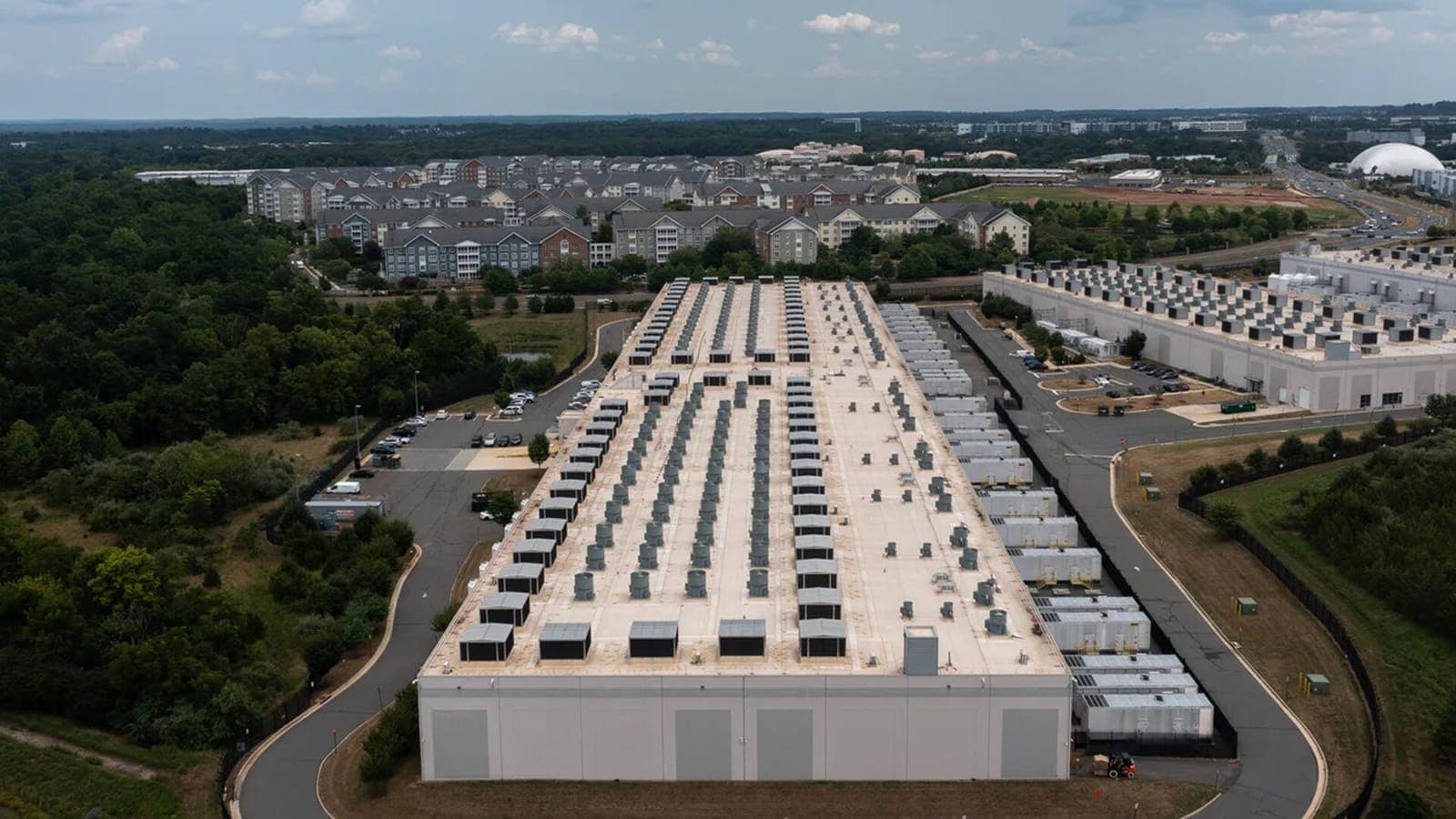
On Wednesday morning, a single transmission line went out of service in Northern Virginia — and in the space of a heartbeat, more than 3 gigawatts of electricity demand disappeared from the largest power grid in the United States. The disturbance that followed, a swing in voltage and frequency, could be registered from Washington, D.C., to Chicago. No neighborhoods went dark and grid operator PJM Interconnection reported no impact to reliability, but the event is one of the clearest demonstrations yet of a new kind of risk that data centers pose to the grid.
The epicenter was Data Center Alley, the dense cluster in Loudoun County, Virginia, that hosts the largest concentration of data centers in the world. When the line faulted, the data centers did exactly what they are designed to do: their own protection systems detected the disturbance and, to shield sensitive equipment, instantly cut themselves off from the grid and switched to backup power. According to Dominion Energy, that customer-initiated disconnection is what pulled the load offline — not a failure of the grid itself.
Why losing demand is a problem
It is easy to assume a grid emergency means losing power plants. This was the opposite, and in some ways stranger. A power grid has to keep supply and demand in constant balance, a balance measured by its frequency, which in North America sits at 60 hertz. When roughly 3 gigawatts of demand — about 3% of everything PJM was serving at that moment — vanishes almost instantaneously, generators that were feeding that load suddenly have nowhere to send their power. Supply overshoots demand, and frequency ticks upward.
PJM, which operates the grid for about 67 million people across a territory stretching from the mid-Atlantic to the Midwest, registered exactly that: a sudden drop in demand and a corresponding change in frequency. Automated systems and operator action absorbed the imbalance, and Dominion said its operators stabilized the situation and returned to normal conditions within minutes. Residents reported only minor problems, if any. But the millisecond-scale automatic responses grids rely on are tuned for losing generation, not for shedding gigawatts of load at once — which is part of what makes these events awkward to manage.
A warning that has now doubled
Grid engineers have seen this movie before, on a smaller screen. In July 2024, a lightning arrestor failed on a 230-kilovolt line in the same corner of Virginia, and about 60 data centers consuming roughly 1,500 megawatts disconnected simultaneously. That event pushed PJM-wide frequency to 60.047 hertz — modest in absolute terms, but well outside the tight band regulators like to hold — before settling back over several minutes. It prompted the North American Electric Reliability Corporation to stand up task forces and issue alerts about the reliability threat posed by large, concentrated loads dropping off in unison.
Wednesday's event was roughly double that one. The concern is not that any single disconnection is catastrophic; it is that the behavior is repeatable, the loads are growing explosively, and the data centers do not necessarily come back quickly once they have transferred to backup power, leaving operators to manage the imbalance for longer than a typical disturbance. As more multi-hundred-megawatt facilities crowd onto the same transmission corridors, the size of a plausible simultaneous drop keeps rising.
The regulatory question underneath
Most of the public debate about data centers and the grid has focused on demand — whether utilities can build enough generation and transmission to feed the AI build-out. This incident points at the mirror-image problem: what happens when all that demand disappears at once. Federal and state regulators are already studying whether data centers should be required to "ride through" grid disturbances rather than reflexively islanding themselves, the way conventional large industrial loads are expected to. The tension is real, because a data center's own protective instinct — disconnect to save the hardware — is precisely the behavior that destabilizes the wider system.
For now, the grid held, and the lights stayed on across PJM's 13-state footprint. The more consequential takeaway is what the event signals about the trajectory: a reliability challenge that grows in lockstep with every new campus that plugs into Data Center Alley, and that the industry and its regulators have not yet fully solved.