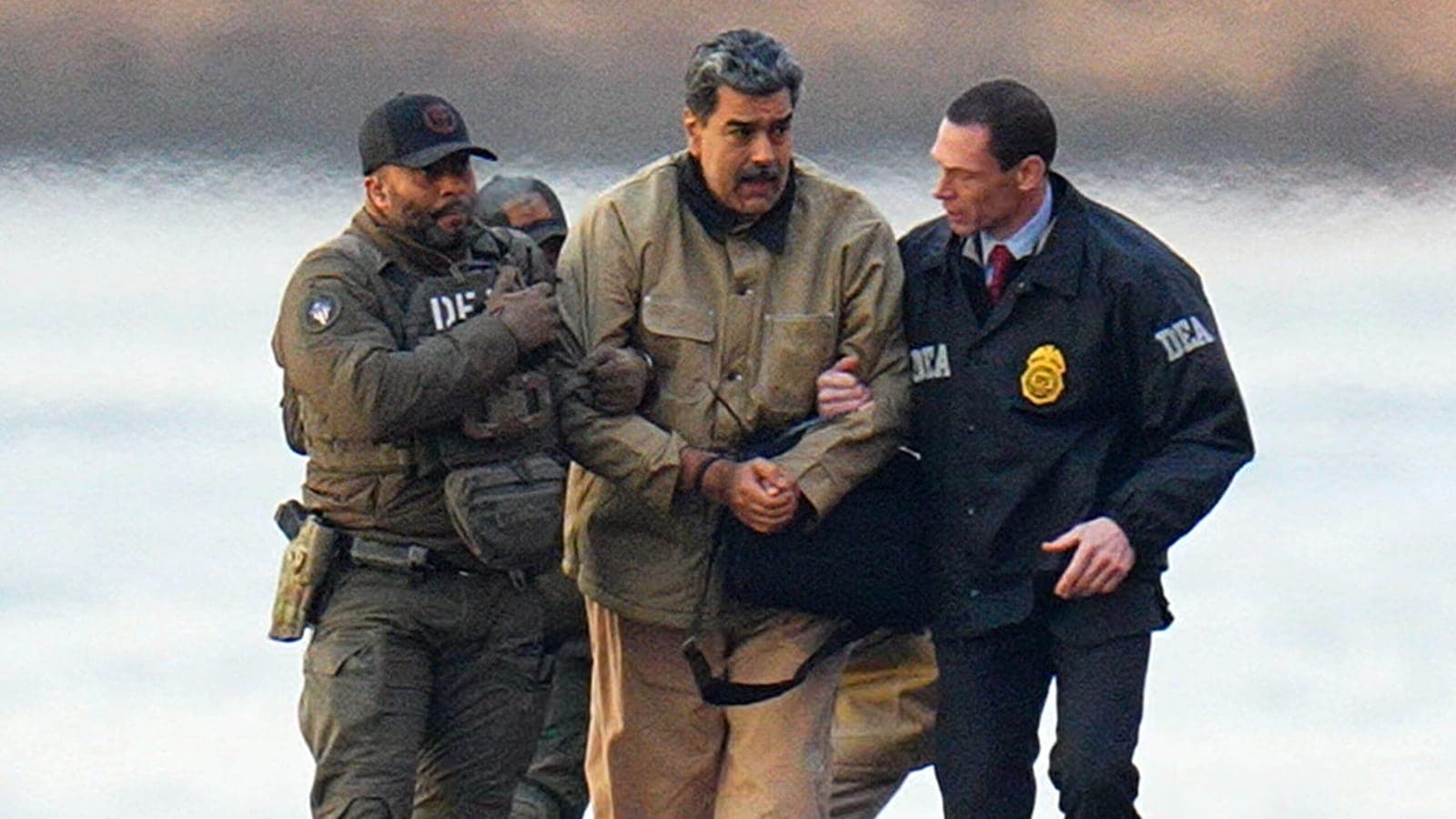
Nicolás Maduro, the Venezuelan president brought to the United States to face criminal charges, returned to a Manhattan federal courtroom on Wednesday for a pretrial hearing in his drug-trafficking case. Maduro, 63, and his wife, Cilia Flores, 69, appeared before U.S. District Judge Alvin K. Hellerstein as the two sides worked through the schedule that will carry the case toward a possible trial. Both have been held at a federal jail in Brooklyn since early January.
The procedural questions before the court are ordinary for a major federal prosecution — when motions are due, when a trial might begin. What makes this case extraordinary is everything surrounding those questions: how Maduro came to be in a New York jail at all, and whether the manner of his capture will survive the legal challenges his lawyers plan to bring.
The charges
U.S. prosecutors allege that Maduro ran a conspiracy to move thousands of tons of cocaine into the United States, colluding with Venezuelan law enforcement to assist drug traffickers. He is one of six defendants named in the indictment, a group that includes Flores, current and former high-ranking Venezuelan officials, and Maduro's son. The defendants are charged with conspiracy to import cocaine into the United States and related weapons offenses.
If convicted, Maduro and Flores could face potential life sentences. Both have pleaded not guilty, and the charges are allegations that the government must prove to a jury; the defendants are presumed innocent unless and until that happens.
How he got here
Maduro's presence in a U.S. courtroom is the product of a dramatic operation. In early January, U.S. forces seized Maduro and Flores from their home in Caracas during a middle-of-the-night raid and brought them to New York. The action was ordered by President Donald Trump, whose administration has defended it as a "surgical law enforcement operation" in a criminal case that was first brought roughly six years ago.
The core drug-trafficking indictment, in other words, is not new — it dates to Trump's first term — but the decision to physically take Maduro into U.S. custody transformed a long-dormant case into an active prosecution overnight.
The defense's central fight
Maduro's legal team is contesting far more than the drug allegations. Maduro has publicly described himself as a "prisoner of war" and called his capture a kidnapping. "I am not guilty. I am a decent man, the constitutional president of my country," he said in Spanish at his arraignment in January.
His lawyer, Barry Pollack, has signaled that he intends to challenge the legality of what he calls Maduro's "military abduction." The defense has argued there are complex legal questions the court must resolve before any trial can proceed — questions about how a foreign head of state was taken from his own country and delivered to a U.S. court. Those threshold disputes, rather than the cocaine allegations themselves, may define the case's early stages.
What Wednesday's hearing addressed
The hearing was focused on the road map ahead: the sequence of pretrial motions and the timing of an eventual trial, with a start sometime in 2027 among the possibilities under discussion. Judge Hellerstein has not yet set a firm trial date. Notably, neither Maduro nor Flores has asked to be released on bail, leaving them in federal detention as the litigation unfolds.
A case sitting on a fault line
The prosecution occupies unusual territory, straddling criminal law and international politics in a way few cases ever do. On one side, U.S. prosecutors present it as a straightforward, if high-profile, narcotics conspiracy that has finally reached a courtroom. On the other, Maduro's defense frames it as an unlawful seizure of a sitting foreign leader that no drug charge can retroactively justify.
Both framings will be tested in the months ahead, and the pretrial fight over the legality of the capture could prove as consequential as the trial itself — potentially shaping whether there is a trial at all. For now, the case moves forward one hearing at a time, with a former head of state in a Brooklyn cell and a set of legal questions the American court system has rarely, if ever, had to answer.