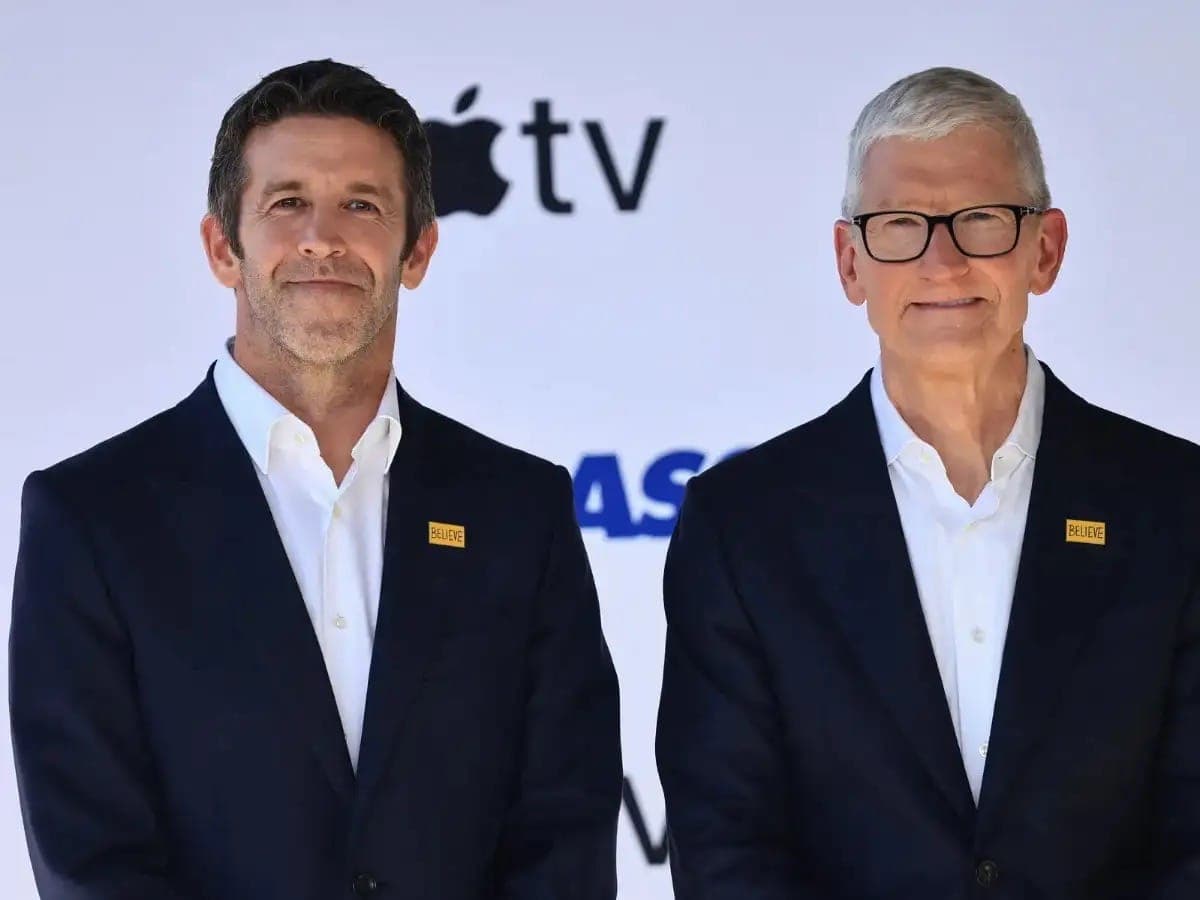
On September 1, John Ternus becomes chief executive of Apple. Tim Cook, after 15 years, becomes executive chairman.
Ternus spent Monday night at the Ted Lasso season 4 premiere in Los Angeles, standing next to Cook in a matching dark suit, each wearing a "Believe" pin. Asked by Deadline what he will do first as CEO, he said: "You have to wait and see."
Then he was asked about Apple TV, and stopped being coy.
The one thing he was willing to commit to
"I am just so excited about the momentum we have. There's so much great content on Apple TV, and now is just the perfect time for us to keep the momentum up."
He praised Eddy Cue and his team. He named no changes.
Read the two answers together and the shape of the message is clear. On everything else: wait and see. On the streaming service: no cuts coming.
Why that is the notable one
Apple TV is the only unprofitable service in Apple's subscription business. It is reported to lose more than $1 billion a year, against roughly 45 million subscribers — against Netflix's few hundred million. Apple has spent north of $5 billion a year on content, a number Cook himself trimmed by about $500 million in 2024.
Every CEO succession is read by employees and investors as a question about what the new person will kill. Apple TV has been the standing candidate — the division that would be first on the block at almost any other company, and the subject of perennial speculation that Apple would sell it, shrink it, or fold it into a bundle and stop trying.
Ternus's answer was to show up at a premiere and say the momentum continues.
The hardware man
This is what makes the venue interesting.
Ternus is not a services executive. He is senior vice president of hardware engineering, 25 years at Apple, the person who ran hardware through the shift to Apple silicon — the most consequential engineering transition the company has made in two decades. He is, functionally, the first hardware engineer to run Apple since the Jobs era.
The reasonable expectation for such a CEO would be a tilt back toward devices, and a colder look at a money-losing entertainment arm assembled under a services-focused predecessor.
Instead his first substantive public position is a defence of the TV business, delivered from a red carpet.
The money says the same thing
Statements are cheap. The spending is not.
Apple has taken US Formula 1 broadcast rights in a five-year deal worth roughly $750 million — about $150 million a year — starting this year. An F1 sequel is in development after the first film's success, which Cook has said makes "more things like that" possible.
That is a company increasing its bet on live sport and theatrical film at exactly the moment its incoming CEO could most easily have justified retrenchment.
What is actually unresolved
"Keep the momentum up" is a commitment to direction, not to spend. It does not say whether the content budget grows, holds or quietly shrinks, and it does not say whether Apple TV is a business expected to make money or a feature expected to sell hardware and hold subscribers inside Apple One.
Those are different strategies, and the difference is where the $1 billion goes.
What to watch
The first budget cycle after September 1. Whether the F1 deal is the start of a live-sports push or a one-off. And whatever Ternus meant by "you have to wait and see" — the answer he gave to every question that wasn't about television.