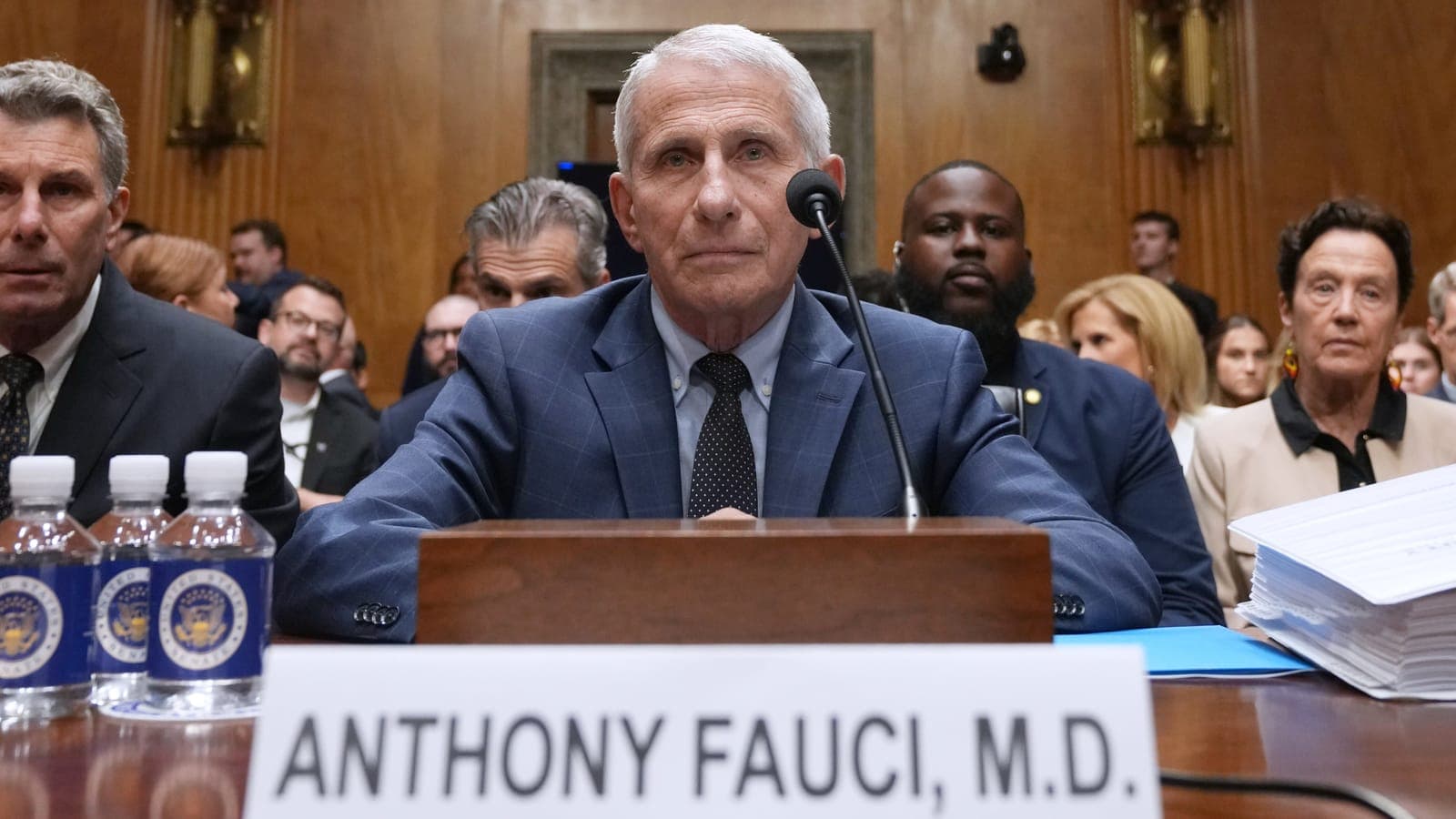
Anthony Fauci sat down in front of the Senate Homeland Security and Governmental Affairs Committee on Wednesday morning, under subpoena, and declined to answer anything.
"Although it pains me to do so, because of the respect I have for the legislative branch of government, and my decades-long record of cooperating with Congress, under the advice of my attorneys, I will invoke my right under the Fifth Amendment of the Constitution to refrain from answering your questions."
By several counts he invoked it more than 100 times. Committee chair Rand Paul has set an August 5 vote on holding him in contempt of Congress.
Start here, because it gets skipped
Invoking the Fifth Amendment is not evidence of guilt. It is a constitutional protection against being compelled to testify against yourself, and it is available to any witness regardless of whether they have done anything wrong.
Lawyers advise innocent witnesses to invoke it routinely, because in an adversarial proceeding truthful answers can still create exposure — through a misremembered date, an inconsistency with prior testimony, or a statement that a prosecutor later characterises differently. That is the entire reason the protection exists.
Anyone treating the invocation as an admission is making a claim the law explicitly rejects. That applies to both directions of the argument here.
The genuinely interesting part: the pardon
President Biden issued Fauci a preemptive pardon in January 2025. It was intended to protect him. It is now the reason his silence is legally contested.
The Republican argument: the Fifth Amendment privilege exists to protect against prosecution. Remove the possibility of prosecution and you remove the basis for the privilege. There is case law supporting the general principle that a witness cannot invoke the privilege as to a pardoned offence, because the hazard it guards against is gone. On that reading, Fauci had no privilege to invoke and his refusal is simply non-compliance with a subpoena — which is what contempt is for.
His lawyers' position: a pardon is retroactive, not prospective. It covers conduct through the date it was issued. It cannot and does not cover anything said at Wednesday's hearing — so a false statement, or a statement later argued to be false, would be freshly prosecutable. Legal analysts also note a federal pardon does not close off every avenue of exposure.
Several outside lawyers described what he did — appear as compelled, then decline to answer — as the safest available strategy, whatever its optics.
The bind is real and it is worth stating plainly: the pardon may have narrowed his right to refuse, while doing nothing to make answering safe. Analysts on both sides agree the scope of the invocation may have to be resolved by a court.
What Paul released, and what it says
Days before the hearing, Paul published more than 1,000 pages of Fauci's private notes covering December 2019 to 2022, plus a 465-page "prequel" of records and emails from 2001 to 2015. He posted them over the weekend, took them down Monday evening, and reposted them Tuesday with redactions. How he obtained them has not been explained; a video posted by Health Secretary Robert F. Kennedy Jr. refers to digging them "out of 11 separate servers."
Paul's claim is that what Fauci "wrote privately and what he told the country are two different stories."
The passages he highlights are these. From February 1, 2020, describing a call with prominent scientists, Fauci wrote that "there was not total agreement" about the virus's origins. Later entries say he is "almost certain that the virus evolved naturally from a species jump, even though … I keep an open mind about the possibility of a lab leak," and that "just because two alternatives are possible that does not mean that they are equally probable."
Readers can judge that for themselves, which is the point of publishing it. Two virologists told NPR the sequence reads as ordinary scientific reasoning. Felicia Goodrum of Dartmouth said early questions about a lab leak were "normal scientific questioning" now being presented as "some sort of signal of guilt." Gigi Gronvall of Johns Hopkins: "It's not unusual that people would be entertaining a variety of opinions or thinking about a lot of different theories and holes in their theories as they go forward. That's kind of what science is all about."
The contrary reading — that private uncertainty alongside public confidence amounts to concealment — is the one Paul is advancing, and it is the question the committee says it wants answered.
Where the science actually stands
This is separable from the hearing and worth stating on its own terms.
A WHO scientific advisory group reported in June 2025, after three years of work by 27 members, that "the weight of available evidence … suggests zoonotic spillover … either directly from bats or through an intermediate host." A peer-reviewed Cell analysis placed susceptible wildlife and the virus together at specific stalls in the Huanan market in Wuhan.
US agencies are split. Some lean toward natural origin; the Department of Energy and the FBI lean toward a lab origin, the DOE with "low confidence" — a formal designation meaning the underlying information is scant, questionable or fragmented.
Lab-leak proponents make a fair point that Western analyses rest on incomplete data supplied by the Chinese government. WHO director-general Tedros Adhanom Ghebreyesus has said all hypotheses must remain on the table and continues to press China for information.
Six years on, this is unresolved, and it is not resolved by anything that happened Wednesday.
The room itself
The hearing was disorderly. Paul had one of Fauci's attorneys removed after he tried to sit at the witness table and did not comply with instructions to stop speaking.
Fauci said Paul's purpose was to get him to say something that would vindicate Paul's repeated public pledges that Fauci end up, in his words, "behind bars," and called the senator unhinged. A letter from Fauci's legal team, sent last month, accused Paul of a "years-long public crusade" and of "single-mindedly fixating on seeing Dr. Fauci prosecuted for imaginary crimes" to the point of having "created a personal brand around it."
Paul did not respond to NPR's request for comment.
What to watch
The August 5 contempt vote, and whether it goes anywhere — referral requires the full Senate, and prosecution requires a Justice Department willing to bring it. Then whether either side seeks a judicial ruling on the scope of the privilege, which is the only forum that can actually answer the question the pardon created.