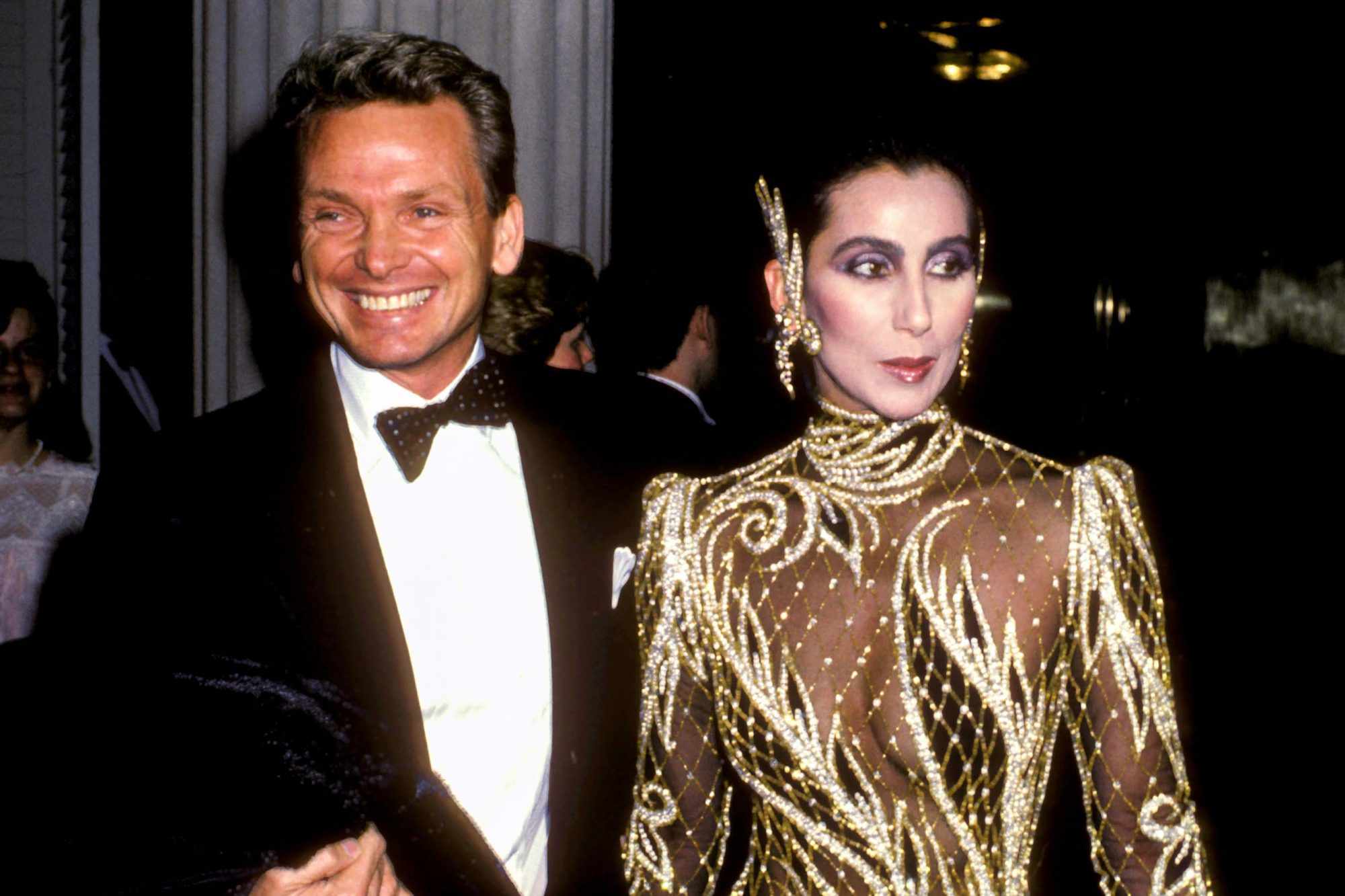
Bob Mackie died on Monday. He was 87. The announcement came from his own Instagram account, and it is worth reading before anything else, because it describes a life with no detours in it:
"He lived his 87 years to the fullest, fulfilling his dream of being a Fashion and Costume Designer, which is all he ever wanted to do."
No cause has been given.
Every obituary today will call him the Sultan of Sequins, list Cher and Carol Burnett and Tina Turner, and run a photograph of something enormous and feathered. All of that is accurate.
It also misses what he was actually doing.
Two dresses, fourteen years apart
In 1962, a sketch artist of about 22 was working for the designer Jean Louis. He drew a flesh-coloured sheath, encrusted with rhinestones, cut so close it had to be sewn onto the wearer. Marilyn Monroe wore it to sing Happy Birthday to President Kennedy at Madison Square Garden, and it became the most famous dress in American history — the one Kim Kardashian borrowed for the Met Gala sixty years later.
The credit went to Jean Louis. The kid who drew it was Bob Mackie.
In 1976, the same man dressed Carol Burnett as Starlett O'Hara for a Gone With the Wind parody. Scarlett famously makes a gown out of her mother's curtains. Mackie made the gown out of curtains and left the rod in — a green velvet dress with a brass pole jutting a foot out either shoulder, worn down a staircase with total composure. Burnett's line, delivered deadpan: "I saw it in the window and I just couldn't resist it."
That dress is now in the Smithsonian.
So here are the two poles of a sixty-year career. The most seductive garment ever made in America, and the funniest. One engineered to look like nothing at all. One engineered to look exactly, ridiculously, like what it was.
Same man. That is the story.
What he was really selling was illusion
The technique everyone calls "sequins" has a more precise name, and the 2024 documentary about him used it: Naked Illusion.
Mackie's signature was nude netting, worked so densely with beads and rhinestones that from six feet away the fabric disappears and what you see is skin wearing light. It is enormously difficult, enormously slow, and it is the reason Cher spent thirty years appearing to wear almost nothing while being, in strict fact, covered from throat to wrist.
That is not decoration. That is a magic trick, and it has a thesis: what a garment is and what a garment appears to be are two different objects, and the space between them is where all the fun lives.
Once you see it, it is everywhere in his work. A dress that pretends to be nakedness. A dress that admits it is curtains. Elton John dressed as Donald Duck, webbed feet and oversized tail, at a 1980 concert in Central Park:
"It was very difficult for me to play the piano, plus the fact I'd never walked in flippers before. I was dancing across the stage, falling over myself, and I just couldn't sing for laughing — because it looked ridiculous, but it looked fabulous."
Ridiculous, but fabulous. There is no better one-line summary of the man's entire catalogue.
He was a comedy writer whose medium happened to be fabric
This is the part that gets lost under the glitter, and Carol Burnett said it plainly.
For eleven seasons Mackie designed The Carol Burnett Show. The number is not a typo: roughly 17,000 costumes, about fifty a week, every week, for over a decade. There is no modern equivalent. There is barely a historical one.
And Burnett, in a 2003 interview, described what he was actually contributing:
"Not all of our sketches were gems. Some were bombs… Sometimes he would put me in stuff that would literally save the sketch."
Read that again. The costume designer was rescuing the writing. On that show, a Mackie dress was frequently the punchline — the first thing the audience saw, landing the joke before anyone opened their mouth. Comic timing, executed in velvet, at fifty pieces a week.
He came by the instinct honestly. Growing up in Southern California, he told the podcast Bullseye last year, he ignored fashion entirely:
"I never looked in a fashion magazine when I was a kid. But I looked in all the movie magazines and theater magazines. That was more interesting to me."
He was never a fashion person who drifted into show business. He was a show business person who happened to sew — which is precisely why he was contemptuous of the runway: "They're just making a cute frock and hope somebody buys it."
The prizes, and the one he never got
Nine Emmy Awards from 32 nominations. The first of them, in 1967, was the first Emmy ever awarded for costume design — shared with Ray Aghayan.
Three Academy Award nominations — Lady Sings the Blues, Funny Lady, Pennies From Heaven — and no Oscar. Not one, across six decades, from the industry whose most-reproduced images he was largely responsible for.
In 2002 he became the first costume designer inducted into the Television Academy Hall of Fame, which is the honour that actually fits, because television is where he lived.
The two people the obituaries will mention in a clause
Ray Aghayan was Mackie's boss first. Mackie started out in the 1960s as his assistant. He then became his partner for the best part of fifty years, until Aghayan died in 2011. That first Emmy, the first ever given in the category, has both their names on it.
Robin Mackie was his only child — born in 1959, from a brief marriage to the singer LuLu Porter that ended in 1963. Robin worked as a makeup artist. He died in 1994, of an AIDS-related illness.
Mackie liked to call himself "the patron saint of drag queens." He was the first guest host on RuPaul's Drag Race and took a lifetime achievement award from it. That line lands as camp until you set it beside 1994, and then it lands as something else entirely: a man who spent his career making armour out of light for people who were told their glamour was a joke, and who buried his son in the middle of the epidemic that was killing them.
RuPaul, in the 2024 documentary, on being able to identify a Mackie across a room:
"There is a rhythm and a movement and a choice of proportions of color that no one else does like that. That's how you know that someone is channeling the divine."
What is left
Marilyn at Madison Square Garden. Cher at the 1986 Oscars in black bondage beading and a feathered Mohawk, the year the Academy declined to nominate her. Tina Turner's fringe. Burnett's curtain rod. A Donald Duck suit. Thousands of Barbies.
He never got the Oscar, and he did not need it, because the work bypassed the prize entirely and went straight into the collective memory. Most people who could describe the Monroe dress from memory have never known who drew it.
They do now.
"The way you dress is your way of telegraphing to the person that's looking at you, who you are and where you're coming from." — Bob Mackie, NPR, 1990
No cause of death has been released. Bob Mackie died on September 14, 2026, at the age of 87.