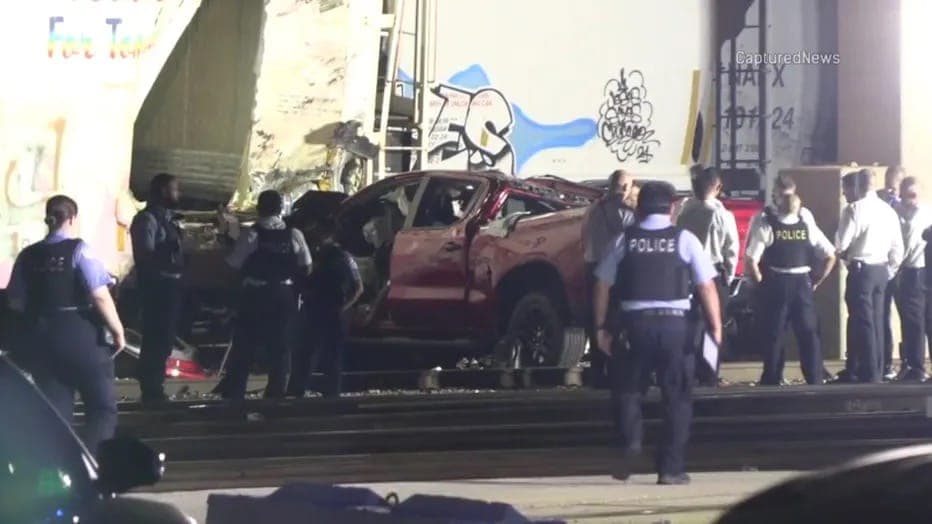
At about 2:16 a.m. on Sunday, a red Chevrolet Silverado left the Cicero Avenue bridge near 69th Street in Bedford Park, travelled through the air, and came down on a freight train box car in the rail yard below.
Three of the four people inside were pronounced dead at the scene about half an hour later. The fourth, Vanessa Morales, 14, of Palatine, died at a hospital at about 5:35 a.m. She was due at freshman orientation at Palatine High School that morning.
"She was so excited," her father said in Spanish. "She was going to get her tablet and meet her teachers today."
Those who were killed
- Cristofer Lopez Montan, 19, of Woodstock
- Yuarem Garcia-Pena, 18, of Woodstock
- Yaritza Martinez Villeda, 17, of Crystal Lake
- Vanessa Morales, 14, of Palatine
All four were from Chicago's north and northwest suburbs. Woodstock High School said one had graduated in May and another had attended about two years ago. Yaritza Martinez Villeda graduated from Crystal Lake Central.
The sequence, as police describe it
Chicago police say officers responded early Sunday to a report that someone in a vehicle had pointed a weapon at another person, and that the Silverado matched the description. Later reporting indicates the night began earlier still — with officers in Morgan Park reporting at about 12:44 a.m. that someone in a Chevrolet pickup had pointed a rifle at them. See the update below.
Officers attempted a traffic stop. The truck did not stop. Officers pursued briefly, then terminated the chase.
A short time later, Illinois State Police spotted the same truck and attempted their own stop, in the 5500 block of South Cicero. The driver initially stopped — then fled again at high speed.
The crash followed shortly after.
The question the family is asking
Vanessa Morales's father does not accept that the pursuit had ended.
"They told me they stopped chasing, but the videos online show something else. They show lots of police cars behind them. I think there are other ways they could have stopped the car."
This is the centre of the story, and it is not resolved. "We terminated our pursuit" and "no one was behind them" are different statements, and only the first has been made. Two agencies were involved within minutes of each other on the same stretch of Cicero Avenue. Chicago police ending a chase does not describe what Illinois State Police were doing afterward.
Both departments have declined to provide additional details about the pursuit. CPD says the investigation is ongoing.
Until either agency releases its own timeline, radio traffic or dashcam video, the father's account and the police account are simply sitting next to each other.
Why pursuit policy is the live issue
Police pursuits are among the most heavily studied and most restricted tactics in American policing, precisely because of outcomes like this one. Research over decades has consistently found that a large share of pursuit-related deaths involve passengers and bystanders rather than the driver who fled — people who made no decision to run.
Three of the four people who died on Sunday were passengers. One was 14.
Departments across the country have narrowed their policies in response, many limiting pursuits to violent felonies, and requiring supervisors to weigh the risk of the chase against the risk of letting a vehicle go. The reported basis here — a weapon pointed from a vehicle — is the kind of allegation that would clear many of those thresholds.
None of which establishes what happened on Cicero Avenue. It establishes why the question of who was behind the truck at 2:16 a.m. is the one that matters, and why an answer should be expected rather than requested.
Update: this started 90 minutes earlier, and the weapon was allegedly pointed at police
Later reporting has filled in the part of the night that came before the pursuit, and it materially changes the picture.
At about 12:44 a.m. — roughly 90 minutes before the crash — officers patrolling the Morgan Park neighbourhood reported that someone in a Chevrolet pickup pointed a rifle at them, near 112th Street and Bishop Street. The truck sped away onto the highway.
Two things about that are worth stating carefully.
It is a different allegation than the one first reported. The initial account described a call about someone pointing a weapon at another person. What CPD officers are now described as reporting is a rifle aimed at officers themselves. That is a far more serious allegation, and it clears the threshold in essentially any pursuit policy in the country.
It also makes this a much longer sequence than a spontaneous chase. By the time the Silverado went off the Cicero Avenue bridge, it had been sought across the city for an hour and a half, through at least three separate encounters with two agencies — Morgan Park at 12:44, Chicago police at around 2:15, and Illinois State Police, who separately observed the truck near 43rd and Cicero at about 2:10 a.m.
Neither point resolves the question the families have asked, which is who was behind the truck at the moment it left the road. But anyone arguing that police escalated a minor traffic matter has to account for the rifle, and anyone arguing this was a brief, contained pursuit has to account for the 90 minutes.
It should also be said plainly: who allegedly pointed the rifle has not been established. Four teenagers died in that truck, aged 14 to 19, and nothing released so far assigns that act to any of them individually.
Update — Monday, August 10: state police radioed for CPD assistance
One detail emerged that spoke directly to the question the families were asking.
When Illinois State Police stopped the Silverado in the 5500 block of South Cicero, the driver pulled over — then sped off the moment troopers began their investigation. At that point, ISP radioed for Chicago police assistance.
That mattered because of what Chicago police had said. CPD's account was that its officers pursued the truck briefly and terminated the chase. Vanessa Morales's father disputed that, saying the videos online "show lots of police cars behind them."
State troopers calling CPD back toward a fleeing vehicle, minutes before it left the bridge, did not by itself prove a CPD pursuit was active at the moment of the crash. But it was the first piece of information in the public domain that described police being drawn back toward the truck at the end, rather than away from it — and it was the sort of detail radio traffic would settle in about thirty seconds.
It has now been settled. See below.
Update — August 16: there were two pursuits, and the second one was Chicago's
A reconstruction of the night built from CPD and Illinois State Police radio traffic, published by Cardinal News, resolves most of what has been contested — and it does so in a way that reframes the police statement everyone has been quoting.
The key point is that there were two separate pursuits, ninety minutes apart, and the public discussion has been collapsing them into one.
The first pursuit lasted about two minutes. At 12:44 a.m. officers reported the rifle pointed at them near 112th and Bishop. The truck went southbound on Bishop, then onto northbound I-57. By 12:46 a.m. the chase was over — terminated by order of a CPD supervisor. Chicago police then notified Illinois State Police.
That is the pursuit CPD was describing when it said officers "pursued briefly, then terminated." The statement was accurate. It was also about an event that ended an hour and a half before anyone died.
The second pursuit is the one that matters. At 2:06 a.m. an ISP trooper found the Silverado southbound on Cicero near Hawthorne Racecourse and — notably — followed it without pursuing, past I-55 and Archer. At 2:14 a.m. the trooper lit it up and stopped it in the 5500 block of South Cicero, with Chicago police officers already present.
Within about a minute the driver ran again. And here is the line that answers the question this story has been built around:
Illinois State Police radio communications indicated the driver was fleeing the traffic stop, while Chicago Police Department officers, who had also responded to assist, were now leading the pursuit.
A CPD unit then reported the truck was driving in the opposing lanes of traffic, southbound on Cicero.
Two minutes later it left the bridge. According to the same reconstruction, Chicago police officers behind the pickup truck witnessed it go over.
What that means for what the family said
Vanessa Morales's father said, three weeks ago: "They told me they stopped chasing, but the videos online show something else. They show lots of police cars behind them."
On this account, he was right, and the department's statement was also literally true. Both things fit, because they were describing different pursuits. CPD terminated one chase at 12:46 a.m. CPD was leading a different chase at 2:16 a.m.
We wrote on July 27 that "'We terminated our pursuit' and 'no one was behind them' are different statements, and only the first has been made." That gap has now been filled, and not in the department's favour.
The honest caveats. This reconstruction comes from a local outlet monitoring police radio, not from either agency. Radio traffic is fragmentary, it is not the same as a formal timeline, and CPD and ISP have had three weeks to correct any of it and have said nothing either way. "Leading the pursuit" is a description broadcast in the moment, not a finding.
But it is specific, timestamped, internally consistent, and it has gone uncontested. Any agency that thought it was wrong could say so.
The policy question this now raises
If the sequence above holds, the questions change.
The first termination was textbook — a supervisor pulled officers off a highway chase within two minutes. Somebody made a correct call at 12:46 a.m.
The ISP trooper's decision to follow without pursuing for eight minutes was also the cautious option, and it worked: the truck was located and stopped without a chase.
What has not been explained is what happened after 2:15 a.m. — how a stop that had succeeded became a pursuit that CPD led, at speed, on a road where the driver was going the wrong way, two minutes from a bridge over a rail yard. Whether a supervisor authorised it, whether anyone weighed the risk, and whether the earlier termination order was still in force are all now specific answerable questions rather than general ones.
Three of the four people in that truck were passengers. One was 14.
Three weeks, nothing released
The recordings themselves have not been released. Neither has anything else.
Three weeks after four teenagers died, neither the Chicago Police Department nor Illinois State Police has provided any further account of the pursuit. No official timeline. No radio recordings. No dashcam or bodycam footage. No public accounting of who was behind the truck at 2:16 a.m. — a question a local outlet has now answered, in outline, by listening to the scanner.
CPD's position remains that the incident is under investigation. No accountability review has been publicly announced.
That is not, in itself, evidence of wrongdoing. Investigations take time, and agencies routinely hold material while one is open. But the practical effect is this: the fullest public account of what police were doing at the moment four teenagers died has been assembled from radio chatter by a suburban news site, while the two agencies that hold the actual recordings, the dashcam footage and the supervisory decisions have said nothing for three weeks.
The video Vanessa Morales's father referred to is on the internet. The video the departments hold is not.
This is a developing story. Police accounts, the status of the investigation and details of the pursuit are subject to change.