The bob is the most searched-for haircut of 2026, and one version has pulled clear of the rest. Searches for the Nordic bob — better known as the Scandi bob — have risen more than 408% in recent months, according to trend data cited by Vogue, making it the breakout cut of the year and one of the most-searched hairstyles of the summer.
The appeal is unusually practical for a trend cut. Stylists say the Scandi bob makes fine hair look close to twice as dense, and it does so through the shape of the cut rather than through daily styling — a rare combination in a year when the wider hair conversation has shifted toward lower-effort, healthier-looking hair.
What a Scandi bob actually is
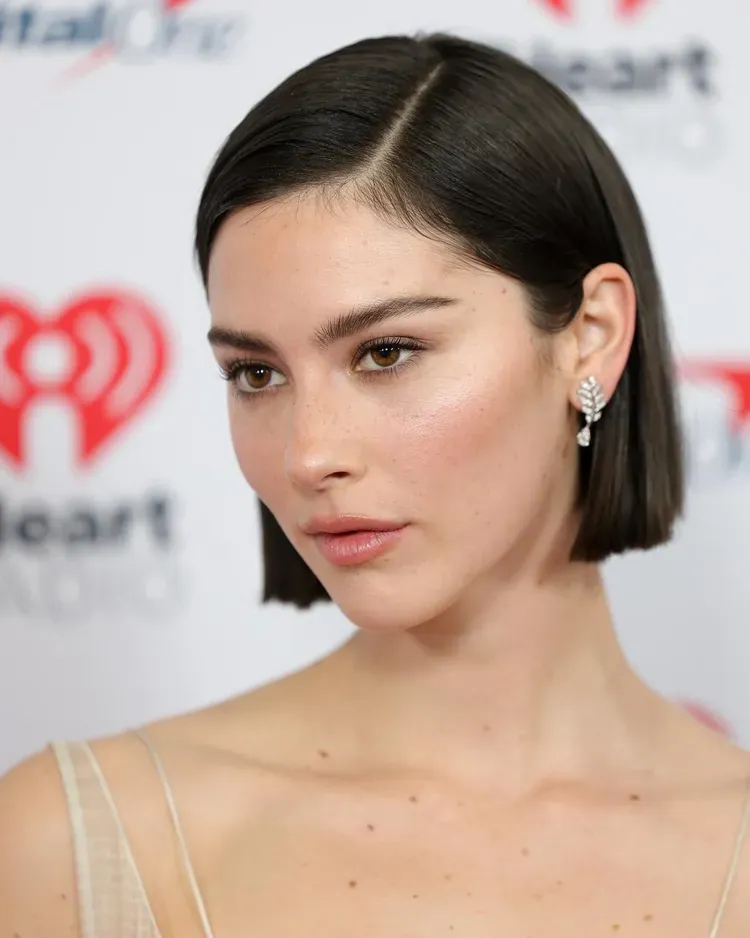
The Scandi bob sits at the jaw or just below it, with a clean perimeter and very discreet layering. The name comes from the Scandinavian minimalism it borrows from: nothing superfluous, nothing overly styled, just a sharp shape softened by natural movement.
The defining detail is the side flip. Rather than forcing the hair into a symmetrical shape, a deep side part lets the front section fall with a little asymmetry around the face. That gesture is what gives the cut its coolness — it looks spontaneous, but the effect only works when there is real precision behind the line.
It is worth being specific about how it differs from its neighbors, because salons use these names loosely. The French bob is shorter, usually paired with a fringe, and reads retro. The Italian bob carries far more volume and depends on a bouncy blow-dry. The Scandi bob has less volume than either and more restraint — hair experts describe it as a blunt bob with soft edges and minimal layers, cut to enhance natural shine and movement rather than fight them.
Why it works on fine hair
The physics are straightforward. Layers remove weight from the interior of the hair, which is what makes thick hair sit flatter — and what makes fine hair look wispy at the ends. A one-length cut does the opposite: every strand ends at the same point, so the perimeter stays dense and the hair reads thicker at the line where people actually notice thickness.
The side part does the rest. Redirecting hair against its natural fall lifts it at the root without any product doing the work, which is why the cut holds its shape on hair that normally goes flat by midday.
The other bobs of 2026
The Scandi bob is the standout, but it is not the only shape stylists are cutting this year.
The stacked bob is the Scandi bob's structural opposite and its closest rival in search interest. Leo Izquierdo, co-founder of IGK Hair Care and stylist to Britney Spears and Hailey Bieber, describes it as hair "graduated and stacked at the back," with lengths "strategically cut shorter underneath and longer on top" to build volume through the crown. In 2026, he says, the approach is "less about harsh angles and more about soft, blended stacking" — which is what makes it workable on finer textures too. Victoria Beckham, Emma Stone, Zendaya and Margot Robbie have all worn versions of it.
The butterfly bob is the season's most "undone" option. Andrew Heasman, international creative director at Rush Hair, calls it one of the top bob trends of summer 2026, describing a cut that "infuses the silhouette of the classic bob with the 'undone' essence of a butterfly cut" — graduated layers, styled with a medium round brush and volumizing mousse.
Heasman also points to the midi bob, which falls between the shoulder and collarbone; the curved lob, a precise shoulder-length cut that curves inward at the ends to mirror the shape of a "C"; the Italian bob, built on a big, bouncy blow-dry; the micro mini bob, which is short enough to air-dry; and the soft bob, a feathered, shoulder-length take on the blunt bob that pairs well with a face-framing fringe.
The through-line across all of them is a move away from the severe blunt bob that dominated the last few years, toward texture, movement and finishes that look less deliberate.
How to style it
Keep the routine light and let the cut carry the look. A volumizing mousse at the roots creates the signature flip, and a round brush during blow-drying gives shape to the front pieces without making the finish rigid.
Straighteners and curling irons tend to work against this cut — they make it look too deliberate, which is exactly what the shape is designed to avoid. A texture spray or a few drops of serum gets closer to the intended finish.
What to ask for at the salon
Names travel badly between salons, so bring a photo. Beyond that, the request that produces this cut is: a blunt, one-length bob at the jaw, with a clean perimeter, minimal layering, no fringe, cut to sit well with a deep side part.
The one honest caveat is upkeep. A blunt line is unforgiving as it grows out — the shape that looks precise at week two looks shapeless at week ten. Most people wearing this cut are back in the chair every six to eight weeks, which is the trade for a style that asks almost nothing of you in between.
Frequently asked questions
What is a Scandi bob? A blunt, one-length bob cut to the jawline or just below, with a clean perimeter and very little layering, usually worn with a side part.
Is the Scandi bob good for fine hair? Yes — it is one of the cuts stylists most often recommend for it. The single length keeps the ends dense and a deep side part adds root lift, which together create the illusion of much thicker hair.
What is the difference between a Scandi bob and a French bob? The French bob is shorter and usually has a fringe; the Scandi bob is longer, fringe-free and built on a precise blunt line rather than on styling.
How often does it need trimming? Every six to eight weeks, because the blunt perimeter shows growth quickly.