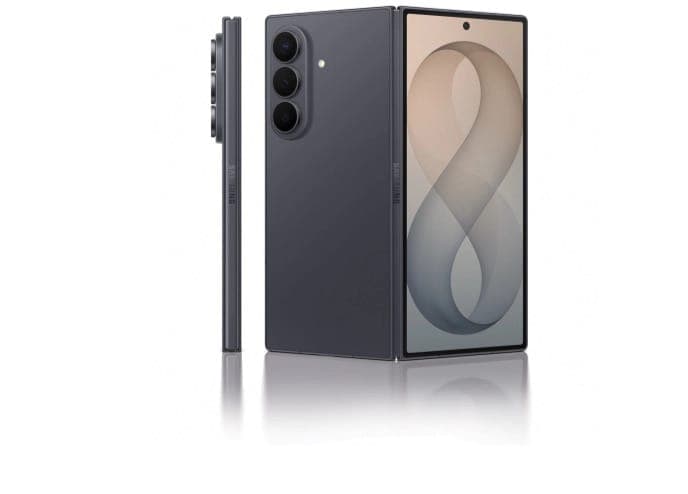
Samsung used its July 22 Galaxy Unpacked event — held in London, a departure from its usual U.S. and South Korea venues — to rethink what a Galaxy Fold is. Rather than a single successor to last year's model, the company introduced two distinct foldables: the redesigned Galaxy Z Fold 8 and, for the first time, a Galaxy Z Fold 8 Ultra. Together with a new Galaxy Z Flip 8, they make up the eighth generation of Samsung's Z series, and they split the Fold lineup into two clearly different devices for two different kinds of buyers.
The move answers a long-running tension in the foldable category: whether a Fold should be a compact, media-friendly gadget or an uncompromising productivity flagship. Samsung's new answer is to stop choosing, and build one of each.
Galaxy Z Fold 8: a foldable reimagined for content
The standard Z Fold 8 gets an all-new form factor, and it is aimed squarely at people who want a foldable mainly for watching, reading and scrolling. It pairs a 5.5-inch cover screen with a 7.6-inch main display, and its new proportions are built around content: unfolded, the screen hits a 4:3 aspect ratio well suited to movies and games, while rotating the device gives a 3:4 shape that feels natural for e-books and web browsing. The cover screen's tall 10:16 ratio, meanwhile, is tuned for short-form video.
Crucially, Samsung made it easier to live with. At 201 grams it is the lightest Galaxy Z Fold yet, and a 4,800mAh battery is rated for more than 26 hours of video playback. The pitch is a foldable that is comfortable to hold for long stretches — positioned, in effect, as an approachable entry point for first-time foldable buyers.
Galaxy Z Fold 8 Ultra: the flagship, thinner than ever
The Z Fold 8 Ultra is the other end of the spectrum: the first "Ultra" model in Samsung's foldable portfolio, carrying the branding the company reserves for its highest performance tier. It keeps the taller, more traditional Fold shape but pushes the hardware hard. Unfolded, it measures just 4.1 millimeters thick and weighs 215 grams — the thinnest Galaxy Z Fold to date — and opens to a spacious 8-inch main display. Samsung's proprietary Flex Titanium technology is used to minimize the display crease and improve durability, and the hinge, magnets and display tension have been retuned for smoother folding.
Under the hood, the Ultra runs Qualcomm's Snapdragon 8 Elite Gen 5 for Galaxy with a 5,000mAh battery, and it leans heavily on AI-powered multitasking. An agentic feature called Now Nudge can anticipate when you need to do two things at once — offering, for example, to open the calendar in a split-screen Multi Window when it spots dinner plans in a chat — while a Gemini Notebook tool can turn uploaded documents or recordings into summaries, slides, videos or quizzes.
Price and availability
The two Folds are priced to match their positioning. The Galaxy Z Fold 8 starts at $1,899 for the 256GB configuration, while the Z Fold 8 Ultra begins at $2,099 for 12GB of RAM and 256GB of storage, rising to $2,299 for 512GB and $2,699 for the 16GB/1TB model; European pricing starts around €2,199. Pre-orders opened alongside the announcement, with general availability set for August 7.
By offering a content-first Fold and a no-compromises Ultra side by side — plus the more affordable Flip 8 — Samsung is betting that the foldable market has matured enough to support real segmentation. Instead of one Fold trying to be everything, buyers now pick the trade-off they want: lighter and easier, or thinner and more powerful.