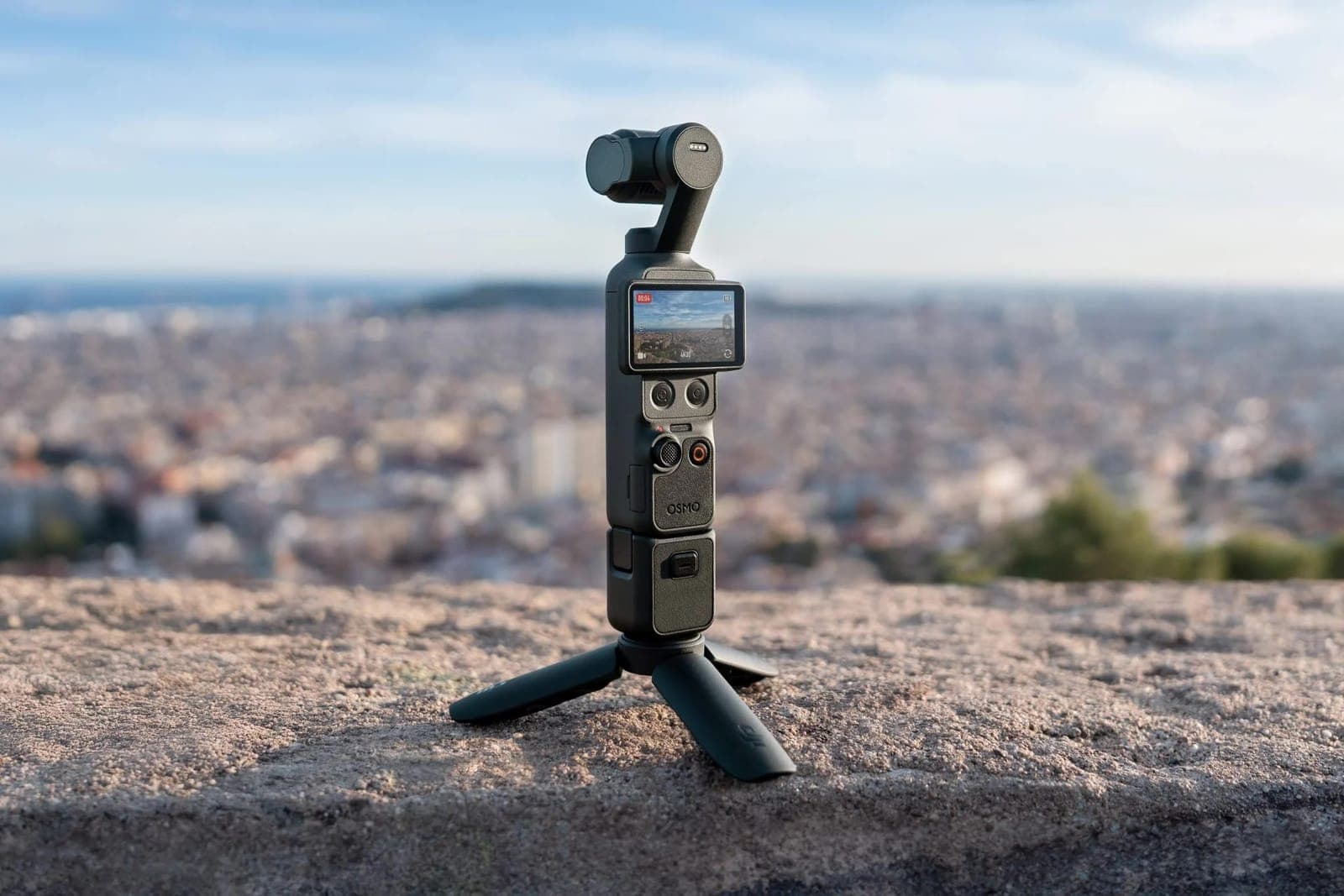
DJI launched the Osmo Pocket 4 on April 16, 2026, during NAB Show week, with shipping beginning April 22. The pocket-sized gimbal camera keeps the 1-inch CMOS sensor and 20mm-equivalent f/2.0 lens from the Pocket 3, but pushes almost every supporting specification: frame rate, dynamic range, color depth, storage capacity and battery life all get upgrades.
The headline change is slow motion. Recording jumps from 4K/120fps on the Pocket 3 to 4K/240fps, enough for 10x slow motion at full 4K resolution. Dynamic range climbs from 12 stops to 14, and the color pipeline moves up from D-Log M to full 10-bit D-Log, giving editors more room to grade footage. The shutter-speed floor also drops from 1/25 of a second down to 1/4, opening the door to light-trail and long-exposure-style shots the Pocket 3 couldn't reach natively.
Storage is the upgrade buyers will feel first. The Pocket 4 ships with 107GB of built-in memory at up to 800MB/s transfer speeds, making a microSD card optional. A 1,545mAh battery delivers roughly two and a half hours of 4K recording and charges from zero to 80% in about 18 minutes. Rounding out the package are ActiveTrack 7.0 subject tracking, intelligent autofocus, gesture control, a new 5D joystick, a dedicated zoom button, and 4-channel audio when paired with DJI's wireless Mic transmitters.
DJI priced the Standard Combo at around £445/€499 and the Creator Combo at around £549/€619, the latter adding the DJI Mic 3, a wide-angle lens, a magnetic fill light and a mini tripod.
Why it matters
The most important detail for American readers isn't a spec — it's that the Osmo Pocket 4 is not for sale in the United States at launch. A DJI spokesperson confirmed the camera will not ship in the US "as the application for authorization is still pending," meaning it can't be bought through any official channel such as Amazon US or B&H Photo.
The block traces to a regulatory decision. On December 22, 2025, the FCC placed DJI on its Covered List under Section 1709 of the 2025 National Defense Authorization Act, after no US national security agency completed a review the law required. That action halted new equipment authorizations for foreign-made drones and has swept up DJI's other new gear too, including the Osmo Nano and Osmo Mobile 8. DJI sued the FCC at the Ninth Circuit in February 2026, and the case remains unresolved.
The practical result is a handheld vlogging camera — no propeller, no aircraft — caught in a policy designed for drones. For now, US creators can buy a tariff-inflated Pocket 3 at domestic retail or import a Pocket 4 from Europe, with the customs paperwork and warranty caveats that route brings. Buyers elsewhere in Europe, the UK and Australia can pick one up today.