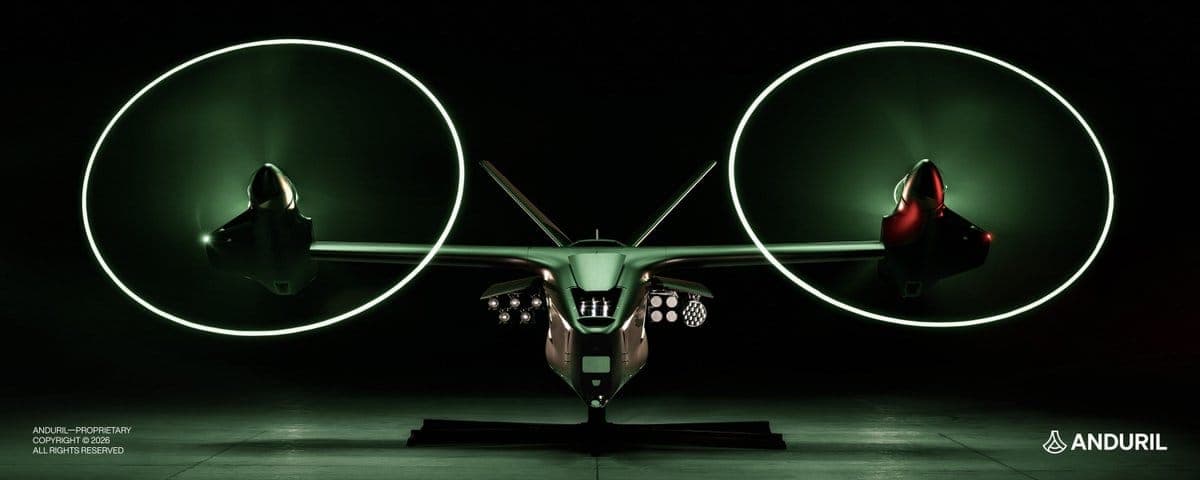
The same category of aircraft that was supposed to whisk commuters over gridlocked cities is now being pointed at the battlefield. At the Farnborough International Airshow on July 20, air-mobility company Archer Aviation and defense-technology firm Anduril pulled the covers off a jointly developed, autonomous, hybrid-electric VTOL — a single platform engineered to serve two very different masters, one commercial and one military.
It is a clean-sheet design, but not a leap into the unknown. The aircraft leans heavily on the years Archer spent building electric vertical-takeoff-and-landing aircraft for passenger travel, taking the propulsion and flight-control lessons of the air-taxi era and adapting them for missions those quiet urban shuttles were never meant to fly.
One airframe, two very different jobs
The platform will come in two versions. The commercial variant is aimed at cargo, with the companies promising more specifics later. The defense variant has a name and a clear purpose: Thunder.
Thunder is designed as an autonomous Group 5 attack rotorcraft — the U.S. military's classification for its largest, heaviest unmanned aircraft — built to multiply the combat power of both current and next-generation crewed attack and assault aircraft. The concept is the one increasingly shaping modern air forces: the "loyal wingman," an uncrewed aircraft that flies alongside piloted ones, extending their reach and absorbing risk while acting as a force multiplier rather than a replacement.
The engineering that makes it work
What lets a single design straddle both roles is its propulsion. Like Archer's passenger aircraft, the new platform uses tiltrotor propellers to transition from vertical takeoff and landing into efficient, wing-borne horizontal cruise — lifting off like a helicopter, then flying like a plane.
The difference is what powers it. A series hybrid-electric powertrain gives the aircraft the range and endurance that military missions demand, well beyond what a purely battery-electric design could sustain, along with the muscle to carry modular, heavy payloads. The dual tiltrotors can vary their RPM to stay efficient across different phases of flight, cutting power draw and fuel burn in cruise. That same variability also trims the aircraft's acoustic signature — a meaningful advantage for a machine expected to slip in low and quiet during the most exposed stretch of a mission.
Years in the making, and not starting from zero
This unveiling is the public payoff of a partnership that has been building since 2024, when Archer and Anduril first announced they would jointly develop a hybrid military aircraft — a deal that came alongside a substantial capital raise for Archer as it pushed deeper into defense. The companies have been filling in details since, including at last year's Dubai Airshow.
Importantly, the program is not beginning with a blank flight-test record. Archer says it has already tested some of the aircraft's systems on other demonstrator platforms, work that feeds directly into the new design. Thunder's first flight is expected in 2027.
A telling pivot for the whole eVTOL industry
The dual-use framing is the part worth watching. The advanced air-mobility sector spent years selling a civilian vision — emissions-light electric aircraft ferrying passengers across metro areas — and has repeatedly run into the hard economics and slow regulatory timelines of standing up an entirely new form of commercial transport. Defense demand offers something that market has struggled to guarantee: deep-pocketed, motivated customers who want autonomy, range, and payload now.
Pairing an air-mobility developer's aircraft expertise with a defense firm's autonomy and go-to-market machinery is a bet that the technology's fastest path to scale runs through the military, not the morning commute. Whether Thunder meets its 2027 flight target will say a lot about how quickly that bet pays off — and the cargo variant waiting in the wings suggests Archer and Anduril intend to work both sides of the aircraft's split personality at once.